

09 Mar Magnesium Oxide Board Manufacturers: Buyer Evaluation Guide
A credible list of magnesium oxide board manufacturers must be based on comparable evidence—not brand mentions, factory claims or paid rankings. MgO panels vary by binder chemistry, chloride content, reinforcement, density, surface, thickness and intended duty. A supplier suitable for interior lining may not have the evidence required for exterior sheathing, structural subfloor or a fire-rated assembly.
This 2026 buyer guide replaces an unverifiable “top 10” ranking with a professional qualification method for architects, contractors, modular manufacturers, distributors and procurement teams.
Why a fixed top-10 ranking is unreliable
Manufacturers sell different products into different jurisdictions. Test standards, report scope, factory locations, production lines, quality systems, order quantities and local support are not directly comparable. Some companies manufacture panels; others import, distribute, private-label or fabricate products made elsewhere.
A shortlist is useful only after the project defines the panel duty, jurisdiction, exposure, framing, finish, required evidence, quantity, delivery program and commercial terms.
MgO manufacturer qualification scorecard
| Gate | Evidence to request | Reject or escalate when | Suggested weight |
|---|---|---|---|
| Product identity | Manufacturer, plant, SKU, formulation, reinforcement, density, thickness, dimensions and edges | Documents do not identify the offered product or factory | 15% |
| Technical evidence | Full reports for required fire, structural, moisture, acoustic or durability claims | Only certificates, screenshots or unrelated test summaries are supplied | 25% |
| Application fit | Declared structural/nonstructural role, permitted exposure and installation manual | Generic board is promoted for every application | 15% |
| Quality control | Factory QC plan, batch traceability, tolerances, inspection and change-control process | No link between shipped batch and approved sample/submittal | 15% |
| Supply capability | Capacity for requested SKU, lead time, MOQ, packaging, loading and delivery plan | Capacity claims are not tied to the order specification | 10% |
| Commercial control | Quotation exclusions, Incoterms, warranty, claims process and document responsibility | Substitution or acceptance responsibilities are unclear | 10% |
| Support | Named technical contact, sample/mockup support and response time | Sales answers conflict with technical documents | 10% |
Weights should be changed to match the project. A fire-critical assembly may assign more weight to recognized listings; a distribution program may emphasize batch consistency, packaging and supply continuity.
Step 1: define the exact panel duty
State whether the proposed board will serve as interior lining, exterior sheathing, tile substrate, ceiling, soffit, subfloor, modular skin, acoustic component or fire-protection layer. Record framing, support spacing, loads, impact, exposure, finish and design life.
Do not accept a broad “MgO board” approval. The submittal should identify the exact SKU and thickness proposed for that duty.
Step 2: verify product and factory identity
Request the legal manufacturer name, production plant, product name, SKU, formulation family and current data sheet. Confirm whether the seller is the manufacturer, exporter, importer, distributor or private-label owner. If several factories can supply the order, require approval and traceability for each source.
For magnesium boards, distinguish magnesium oxychloride from magnesium oxysulfate formulations and document relevant chemistry. A “chloride-free” claim should be supported for the exact product rather than inferred from a brand family.
Step 3: audit every test claim
Match manufacturer, plant, SKU, thickness, reinforcement, surface and specimen conditioning to the offered product. Record the test standard, laboratory, report number, date, specimen, method, result and limitations.
Reaction-to-fire classification is not the same as an hourly assembly rating. Water absorption does not prove a wall is waterproof. Bending strength does not automatically establish racking or diaphragm capacity. A result for one thickness or formulation should not be applied across a product range without documented scope.
Step 4: review quality control and change management
Ask how incoming raw materials, formulation, mixing, curing, reinforcement placement, dimensions, density, moisture, surface and edge profile are controlled. Define batch identification and what production records accompany the shipment.
The contract should require notice and approval before changes to formulation, reinforcement, factory, thickness, surface, edge or critical process. A pre-production sample is useful only when the delivered batch remains traceable to it.
Step 5: test supply and logistics readiness
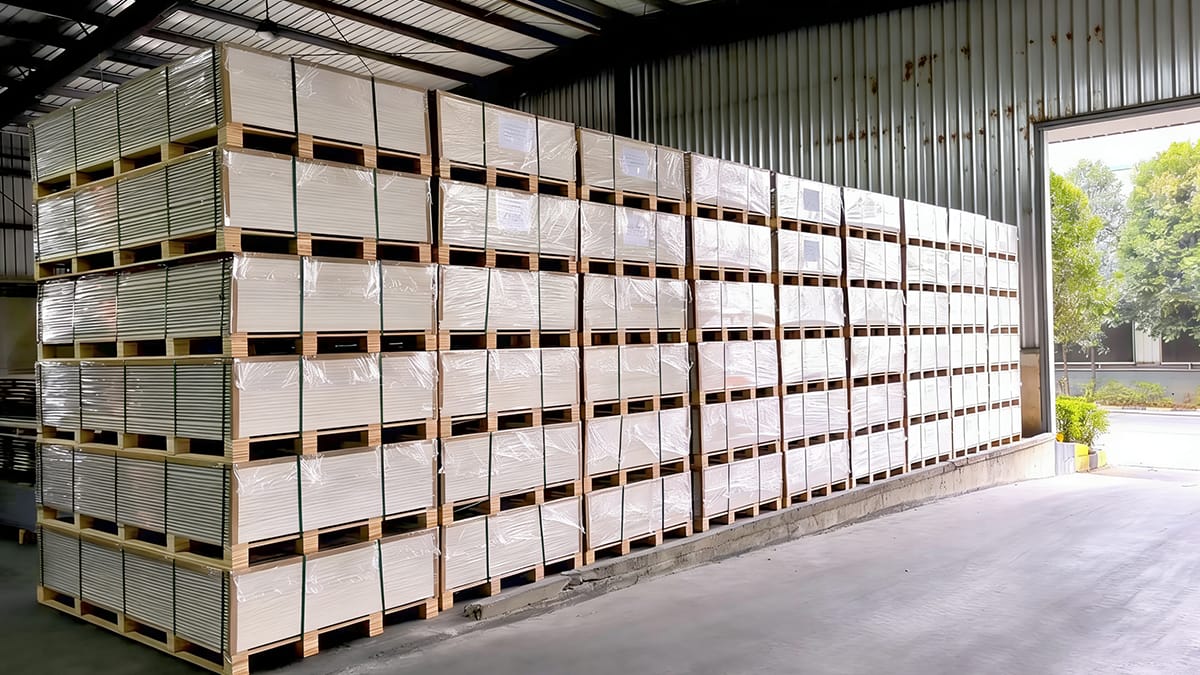
Confirm available dimensions, thicknesses and edges; order quantity and MOQ; production and document lead times; pallet and container configuration; corner and moisture protection; loading method; destination restrictions; and replacement procedure for transit damage.
Capacity should be stated for the proposed SKU and quality level, not as a general factory headline. For phased projects, define batch-to-batch consistency and retention samples.
Step 6: compare installed cost
Compare more than price per sheet. Include freight, duties, packaging, unloading, storage, breakage, cutting, extraction, fasteners, joint treatment, coatings, labor, waste, testing, mockups and approval costs. Also account for the cost of late or nonconforming documents.
Red flags when evaluating MgO board suppliers
- “Fireproof,” “waterproof,” “non-toxic” or structural claims without exact methods and reports
- Test reports that name a different company, plant, product, thickness or formulation
- Certificates without the underlying report, scope, validity or issuing body
- One generic installation sheet for incompatible applications
- No declared formulation or refusal to discuss chloride and fastener compatibility
- No batch number, tolerances, change control or nonconformance procedure
- Unclear manufacturer/importer responsibility and warranty jurisdiction
- Pressure to approve production before sample and document review
Supplier comparison request template
- Project, jurisdiction, building type and intended panel duty
- Framing, spacing, spans, loads, exposure and finish
- Required standards, classifications, assembly ratings and acceptance route
- Exact SKU, formulation, thickness, dimensions, reinforcement, surface and edges
- Full technical reports, data sheet, safety data and installation manual
- Factory QC, tolerances, batch traceability and change-control information
- Sample/mockup requirements and approval sequence
- Quantity, MOQ, packaging, Incoterms, destination and delivery schedule
- Quotation exclusions, warranty and claims process
How Sulfycor should be evaluated
Sulfycor should be reviewed using the same gates as every other supplier. The company identifies itself as a magnesium oxide sulfate board manufacturer and states that its boards are chloride-free. Buyers should request documents for the exact offered SKU, thickness, application and factory batch and verify that critical claims match the project requirements.
The internal material available for this content program does not identify a laboratory, full report number, specimen/SKU, thickness or date for several summarized test values. Those summaries are not used here as universal product claims. Request the underlying documents for the offered product.
Normalize technical evidence before scoring suppliers
A procurement team cannot compare two manufacturers if one submits a complete report for a named product and the other submits a certificate image or marketing table. Build an evidence register before awarding points. For every required characteristic, record the exact claim, test method, specimen identity, conditioning, laboratory, report date, result, limitations and project acceptance route.
Start with mandatory gates rather than weighted preferences. If the project requires a particular reaction-to-fire classification, structural value or complete assembly rating, an offer without applicable evidence should remain technically noncompliant regardless of price. Apply weighted scoring only after all shortlisted products pass the mandatory gates.
Check that translations and excerpts preserve the meaning of the original report. A cover page, classification page or declaration may help navigation, but it may omit specimen construction, mounting, conditioning, deviations and field-of-application limits. Ask for the complete document and have the responsible designer or compliance specialist review it.
Use samples, mockups and pilot orders for different questions
A small sample can show surface, edge, thickness, basic machining and finish compatibility. It cannot establish shipment consistency, structural capacity, long-term exposure or complete assembly performance. Label the approved sample with product name, plant, formulation family, thickness, density range, surface, edge, production date and batch number so it becomes a controlled reference rather than an anonymous board.
A project mockup should include the actual framing, fasteners, joints, primers, coatings, membranes, adhesives or finishes that matter to the intended use. Inspect cutting, screw setting, edge behavior, joint visibility, movement and finish quality. Include corners, openings and service penetrations where these interfaces drive risk.
A pilot order tests the supplier’s document flow, packaging, production repeatability, labeling, loading, transport protection and nonconformance response. Define acceptance criteria before production. Retain samples from the approved pilot and later batches when traceability or dispute resolution is important.
Audit the quotation as carefully as the data sheet
Make every supplier quote the same schedule. State units, currency, Incoterm, dimensions, thickness, edge, surface, formulation, quantity, packaging, pallet limits, documentation, inspection, destination and requested delivery program. Separate board price from tooling, samples, testing, packaging, inland transport, export charges, ocean or air freight, insurance, duties, taxes and destination handling.
Record exclusions and assumptions. A low board price may not include protective packaging, third-party inspection, special labeling, replacement for transit damage or the reports needed for submittal. Conversely, a local distributor’s higher sheet price may include stock, smaller releases, local technical support and simpler claims handling. Compare the delivered, approved and installable package—not only the factory-gate unit price.
Define production and shipment hold points
A robust purchase order identifies the points at which work cannot proceed without written approval. Typical hold points include final technical submittal, approved sample, packaging drawing, pre-production meeting, first-off inspection, pre-shipment inspection and release of shipping documents. State who can approve each point and how deviations are recorded.
Inspection should match the risk. Possible checks include dimensions, thickness, squareness, edge profile, surface condition, identification, package count and visible damage. Laboratory retesting may be appropriate for selected characteristics, but the sampling plan, method, laboratory and acceptance criteria must be agreed in advance. A random test performed without a defined specification can create argument rather than control.
Require a nonconformance process covering segregation, root-cause review, corrective action, replacement or credit, and approval before any use-as-is decision. The supplier should not substitute formulation, reinforcement, thickness, factory or critical raw material simply because the commercial product name remains unchanged.
Record the final selection decision
Keep a short decision record that shows why a supplier passed, failed or remained conditional. List mandatory gates, unresolved qualifications, score, commercial comparison, sample/mockup outcome, supply risks and the person responsible for closing each item. This protects the project from a late decision based on familiarity, a sales presentation or a single headline price.
A conditional selection should state the deadline and evidence needed to become approved. If two suppliers remain technically acceptable, consider whether a primary and qualified alternate source reduce supply risk. Do not assume that two products with similar descriptions can be exchanged without reviewing their reports, installation details and project approvals.
Frequently asked questions
Who is the best magnesium oxide board manufacturer?
There is no universal best. The best-qualified supplier is the one whose exact product evidence, quality control, installation system, supply plan and commercial terms match the project.
Is a manufacturer certificate enough?
No. Review the underlying report or recognized listing, exact specimen and scope. Confirm that it applies to the offered SKU and assembly.
Should buyers prefer a factory over a distributor?
Not automatically. A distributor may provide valuable local stock and technical support. Verify the manufacturer, traceability, document chain and allocation of responsibility.
How many suppliers should be shortlisted?
Enough to create a credible technical and commercial comparison, usually after mandatory evidence gates remove noncompliant offers. Quality of comparable data matters more than a fixed count.
Request an MgO board manufacturer submittal
Send Sulfycor your panel duty, drawings, framing, exposure, required standards, thickness, dimensions, quantity, destination and delivery program. We can identify relevant magnesium board products and provide available samples, technical documents and quotation inputs.