


10 Sep Duct Board vs MgO Board: Functions and Intended Uses
Duct board and MgO board are not interchangeable product names. In North American HVAC usage, duct board usually means a rigid, faced fibrous-glass panel that can be cut and folded into insulated air-distribution ducts. MgO board is a mineral building board with a different composition and evidence route. In Sulfycor’s target application, fire-protection boards form the duct body and metal connectors join the boards into duct sections, but the complete construction still has to be evaluated and accepted as a system.
The practical purchasing question is therefore not “Which board is better?” It is “Which board category and documented construction match the duct function, fire exposure, operating conditions, joint design, and approval route?” A generic duct board listing cannot be substituted for an MgO component, and an MgO board data sheet cannot replace the complete duct assembly documentation.
What Does Duct Board Usually Mean?
The term has more than one market use, but English-language HVAC search results are dominated by fibrous-glass air duct board. The U.S. Department of Energy’s building-science guidance on HVAC fiber board ducts describes flat fibrous-glass sheets that contractors fabricate into heating and cooling duct sections. The board itself combines the duct wall with thermal insulation, and the finished result depends on how sections are formed and joined.
A current manufacturer example, Knauf Performance+ Air Duct Board, is positioned around thermal and acoustic performance for air delivery. Its published product information also identifies fabrication, pressure, velocity, temperature, facing, and test details. Those details belong to that specific product and must not be generalized to every material sold as duct board.
Other suppliers use similar wording for phenolic, PIR, or other pre-insulated panels. This is why the search term alone does not establish composition. A buyer should identify the core material, facings, intended duct service, joining method, manufacturing standard, and supporting certification before comparing quotations.
Three separate product categories are often confused
- Air duct board: a panel intended to form an air-distribution duct, often with integrated insulation and facing.
- Duct liner or insulation board: a thermal or acoustic product installed inside or around a separate duct body.
- Fire-protection board for a documented duct construction: a rigid board used in a fire-resisting build-up, which may form the duct body or protect another duct depending on the evaluated design.
These products may all appear under broad HVAC or duct-insulation categories, but they perform different jobs. A surface-burning result, an insulation value, or a factory-made air-duct listing answers only the questions covered by that test or listing.
What Is MgO Board in Sulfycor’s Duct Application?
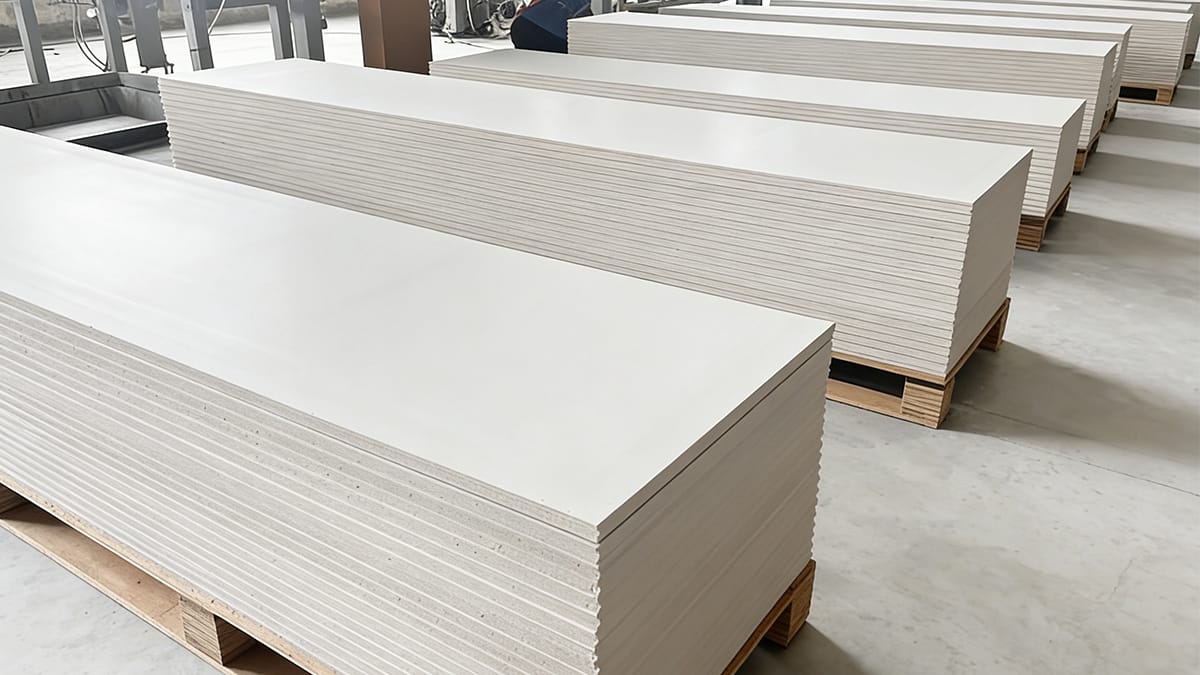
Magnesium oxide board is a rigid mineral board supplied in flat sheets. Sulfycor supplies the board component to businesses that fabricate fire-rated ductwork. In the intended board-built format, the fire-protection boards create the rectangular duct body and metal connectors join the boards into sections. Sulfycor does not sell a complete installed duct system, flexible duct wrap, or a generic insulated residential HVAC duct board.
The Sulfycor fire-rated ductwork application page is the correct starting point for discussing the board component. Board formulation, dimensions, edge condition, tolerances, fastening interfaces, and the documentation supplied for a particular project must be reviewed against the duct fabricator’s approved construction.
Fire language also needs careful separation. The MgO board fire-rating evidence guide explains why non-combustibility, surface-burning behavior, reaction-to-fire classification, and assembly fire resistance are different evidence categories. A board result does not automatically establish a one-hour or two-hour rating for a duct made from that board.
Duct Board vs MgO Board: Function and Evidence Comparison
| Comparison point | Typical HVAC duct board | MgO board in Sulfycor’s target application | What the buyer must verify |
|---|---|---|---|
| Material family | Often resin-bonded fibrous glass with an exterior facing; other pre-insulated panel types also exist. | Rigid magnesium oxide mineral board supplied as a flat component. | Exact composition, facing, formulation, thickness, density, and declared product scope. |
| Primary market function | Fabrication of insulated HVAC air-distribution ducts or plenums. | Board component for a documented board-built fire-rated duct construction. | Duct service, fire exposure, operating condition, and approval route. |
| Duct body | The panel is commonly cut and folded to form the air duct wall. | The board forms the duct body and metal connectors assemble the sections in the target format. | Permitted panel orientation, joints, connectors, supports, branches, and access details. |
| Thermal and acoustic role | Frequently marketed with integrated thermal insulation and sound absorption. | Must be determined from the specific board data and complete construction; no generic equivalence is assumed. | Declared conductivity, acoustic data, condensation control, and whether extra insulation is required. |
| Fire evidence | May include factory-made air-duct, surface-burning, or product-specific fire tests. | Board-level test reports plus assembly-level duct evidence appropriate to the project. | Test object, standard, exposure direction, duration, specimen details, and field-of-application limits. |
| Substitution risk | Changing brand, core, facing, or closure system can move outside the listed construction. | Changing board formulation, thickness, connector, joint, or support can move outside the assessed duct construction. | Written confirmation from the responsible system owner, designer, or approving authority. |
Why a Direct Material Swap Is Unsafe
A direct swap fails because the product name does not carry the construction details. A fibrous-glass air duct board may combine an air barrier, vapor retarder, insulation, and duct wall in one panel. An MgO board component may require a different connector geometry, sealing approach, reinforcement method, support spacing, surface treatment, and insulation strategy. Even when two boards have similar dimensions, their permitted joints and evidence may be unrelated.
The applicable test route can also differ. UL Solutions’ overview of UL 181 describes evaluations for factory-made rigid and flexible air ducts that include fire, material, and integrity tests. That does not make UL 181 a generic hourly fire-resistance rating for every duct application. Fire-resisting ventilation or smoke-control ducts require evidence that matches the relevant construction, exposure, criteria, and project jurisdiction.
Substitution should therefore be a controlled engineering and approval decision. The supplier can provide board information, but the duct fabricator and project team must confirm how the board integrates with connectors, joints, supports, penetrations, access components, and the surrounding construction.
Use This Decision Path Before Requesting a Quote
- Define the duct service. State whether the duct is for ordinary supply or return air, smoke extraction, kitchen extract, or another specific duty.
- Identify the required construction format. Confirm whether the project needs a pre-insulated HVAC duct, a metal duct with protection, or a board-built duct body joined with metal connectors.
- Name the governing evidence. Provide the project standard, required rating or classification, exposure direction, and acceptance route.
- List operating conditions. Include pressure, velocity, temperature, humidity, internal environment, cleaning needs, and corrosion considerations where relevant.
- Request component compatibility. Match the board to the connector, joint, sealant, support, access-door, penetration, and branch details in the documented construction.
- Control substitutions. Do not replace a listed or assessed component based only on a similar thickness, density, appearance, or fire-related marketing phrase.
Documentation Checklist for Board-Built Fire-Rated Ductwork
A useful inquiry contains enough detail for the board supplier and duct fabricator to identify the intended evidence set. Ask for documents that refer to the actual board and construction under review rather than a generic company brochure.
- Board product name, formulation, manufacturing location, dimensions, tolerances, and edge condition.
- Applicable board-level reports with sample description, thickness, date, laboratory, and test standard.
- Assembly-level fire-resistance test, assessment, listing, or approval for the duct construction where required.
- Connector material and geometry, joint treatment, fasteners, sealants, reinforcements, and permitted openings.
- Support and hanger details, maximum dimensions, orientation, branch and transition limits, and access components.
- Handling, cutting, storage, finishing, and compatibility instructions from the responsible supplier or system owner.
- Written confirmation of any proposed substitution and the party authorized to approve it.
This information also improves quotation quality. A board price alone does not establish the installed system cost because connectors, fabrication labor, supports, closures, insulation, transport, waste, access details, and approval work can change the total.
Frequently Asked Questions
Is duct board always made from fiberglass?
No. The term commonly refers to fibrous-glass air duct board in North American HVAC use, but suppliers also apply it to other pre-insulated panel systems. Read the composition and intended-use documents instead of relying on the category name.
Can MgO board replace fiberglass duct board?
Not as a direct generic substitution. The two products have different material functions, joining details, performance declarations, and evidence routes. MgO board should be specified only within a construction that permits the exact board and related components.
Does a noncombustible board make the duct fire rated?
No. Non-combustibility is a board-level characteristic. A fire-rated duct claim depends on the complete construction and the applicable test or assessment, including joints, connectors, supports, penetrations, access components, dimensions, orientation, and exposure.
What does Sulfycor supply?
Sulfycor supplies MgO boards to ductwork businesses. Customers fabricate the board-built duct sections using the specified boards and metal connectors. Project teams remain responsible for the complete construction, system evidence, installation, and approval.
Discuss the Board Component for Your Duct Construction
If your project uses fire-protection boards as the duct body with metal connectors, send Sulfycor the required standard or approval route, duct service, exposure, board dimensions, connector concept, and available assembly documentation. We can then review the requested MgO board component and identify which board-level documents are available.
Contact Sulfycor with your ductwork specification and documentation checklist.