


08 May MgO Board Fire Rating: Non-Combustibility vs Assembly Fire Resistance
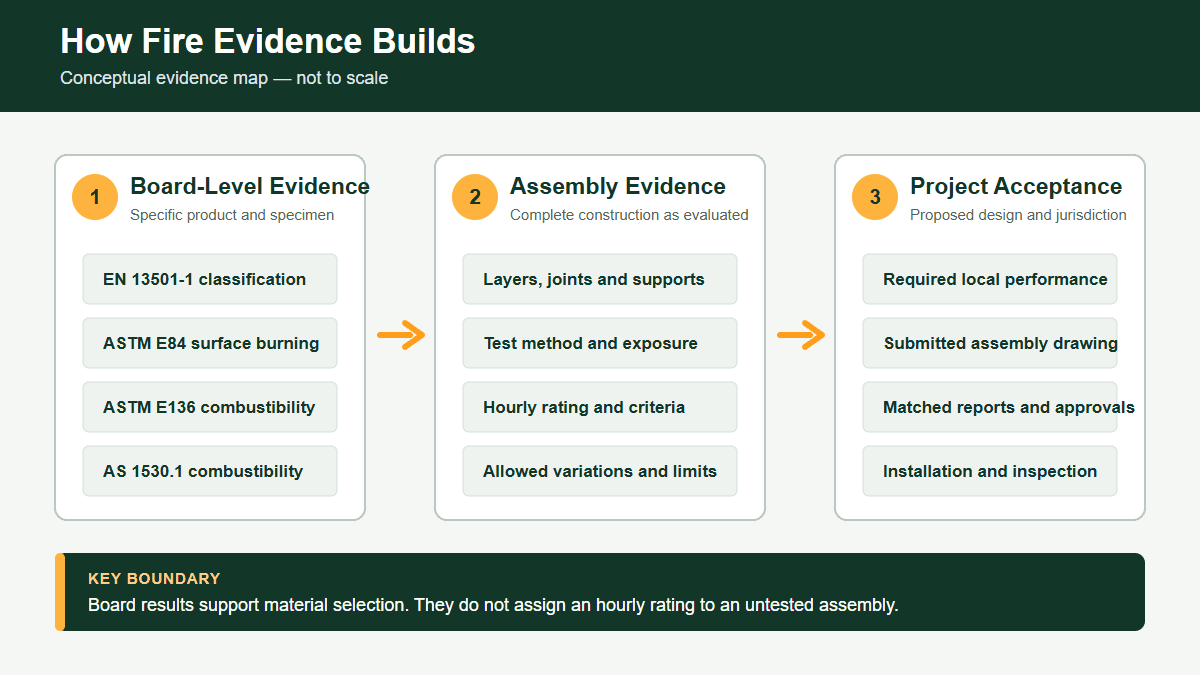
An MgO board fire rating can describe several different types of evidence. It may refer to a reaction-to-fire classification, a surface-burning result, a material combustibility test, or the fire resistance of a complete assembly. These terms answer different questions and should not be treated as interchangeable.
For a buyer, the practical issue is not whether a document contains the word “fire.” The issue is whether the product, specimen, test method, construction, and intended application in that document match the proposed project. Sulfycor has board-level reports for specified samples. Those reports do not, on their own, give an untested wall, floor, ceiling, or duct a one-hour or two-hour rating.
What Does an MgO Board Fire Rating Mean?
The phrase MgO board fire rating is commonly used for four separate evidence categories. Identifying the category first prevents a material result from being expanded into a system claim.
- Reaction to fire describes how a construction product contributes to fire under specified test and classification rules. The European A1–F framework is one example.
- Surface burning compares flame spread and smoke developed along an exposed surface under controlled tunnel-test conditions.
- Material combustibility evaluates a specified specimen against the criteria of a test method such as ASTM E136 or AS 1530.1.
- Fire resistance evaluates a complete construction for a defined period and performance criteria. The board is only one part of that construction.
This distinction also explains why “non-combustible” and “two-hour fire rated” are not synonyms. The first may describe a material result. The second normally depends on the complete tested or assessed assembly, including framing or duct construction, layers, joints, fasteners, supports, penetrations, and exposure conditions.
Sulfycor Board Reports at a Glance
The table below summarizes the fire-related documents reviewed for this article. Each statement is tied to the submitted product or specimen described in the corresponding document.
| Document | Tested or Declared Scope | Recorded Result | What It Does Not Establish |
|---|---|---|---|
| EN 13501-1 Intertek 241217005SHF-001 | Submitted 12 mm Sulfycor magnesium sulfate/MGO board; data from EN ISO 1182:2020 and EN ISO 1716:2010. | Reaction-to-fire classification A1 under EN 13501-1:2018. | An hourly rating for a wall, floor, ceiling, or duct. |
| ASTM E84 Intertek 241111004SHF-001 | Approximately 12 mm board; smooth face exposed; specimen self-supported under ASTM E84-23. | Flame Spread Index 0 and Smoke Developed Index 0. | Non-combustibility from FSI alone, heat transmission, or hourly fire resistance. |
| ASTM E136 Intertek 241127003SHF-001 | 12 mm board used in four stacked layers to form the specified ASTM E136-24c specimens. | The test specimens met the ASTM E136-24c requirement. | The performance of a full-size field installation or complete assembly. |
| AS 1530.1 Intertek 250418003SHF-001 | Approximately 12 mm board evaluated under AS 1530.1:2024. | The report records the material as “not deemed combustible.” | Behavior outside the specimen and conditions described by the report. |
Sulfycor also maintains a manufacturer Declaration of Performance for MGO Board under EN 12467:2012+A2:2018. It declares reaction-to-fire Class A1 and lists wall sheathing, ceilings, and subflooring as intended uses. A declaration should be identified as a declaration; it is not a substitute for a complete duct-system fire-resistance report.
Why A1 Is Not an Hourly Assembly Rating
A1 is part of the European reaction-to-fire classification system for construction products. The classification addresses contribution to fire using defined test data and criteria. The official European reaction-to-fire classification framework identifies temperature rise, mass loss, flaming duration, and calorific potential among the relevant measures for A1 products.
Sulfycor report 241217005SHF-001 classifies the submitted 12 mm product as A1 under EN 13501-1:2018. Its result page records a temperature rise of 1.4°C, mass loss of 30.6%, sustained flaming of 0 seconds, and calorific-potential data for the product and its declared components. Those values should remain connected to that report and product description.
An hourly fire-resistance rating asks a different question: how long a specified construction maintains defined performance when exposed according to an assembly test. UL Solutions’ fire-resistance terminology explains that an hourly certification applies to assemblies and construction methods that satisfy the relevant assembly test criteria. A board classification cannot supply missing evidence for joints, framing, supports, openings, or another construction detail.
What ASTM E84 FSI 0 and SDI 0 Show
ASTM E84 is a surface-burning test. Sulfycor report 241111004SHF-001 describes an approximately 12 mm specimen with its smooth face exposed and records a Flame Spread Index of 0 and Smoke Developed Index of 0 under the specified ASTM E84-23 method.
Those indices are useful when the project asks for comparative surface-burning information. They should be quoted with the tested product, thickness, exposed face, mounting, report number, and standard edition. The current ASTM E84 scope and limitations state that the method provides comparative surface flame-spread and smoke-density measurements. It does not measure heat transmission through the surface, and a flame-spread index by itself does not define a material as non-combustible.
FSI 0 therefore should not be rewritten as “zero fire risk,” “two-hour rated,” or “approved for every fire-rated application.” Those are different conclusions that require different evidence.
What ASTM E136 and AS 1530.1 Show
ASTM E136 assesses material combustibility using a vertical tube furnace under specified laboratory conditions. Sulfycor report 241127003SHF-001 identifies a 12 mm board and explains that four layers were stacked to make the required specimen geometry. The four specimen observations record no smoke or flame, and the report concludes that the specimens met ASTM E136-24c.
The official ASTM E136 scope notes that materials passing its criteria are typically classified as non-combustible materials. It also sets clear limitations: the laboratory exposure does not reproduce all actual building-fire conditions, the specimen is not tested in the form of a field installation, and the method is not a quantitative fire-risk assessment.
For Australia, report 250418003SHF-001 evaluates an approximately 12 mm board under AS 1530.1:2024. It records a mean furnace temperature rise of 5.3°C, mean specimen-center rise of 0.2°C, mean specimen-surface rise of 0.5°C, sustained flaming of 0 seconds, and mean mass loss of 26.5%. The report conclusion is “not deemed combustible.” Its own note limits that conclusion to the behavior of the test specimens under the particular test conditions.
The two methods should not be presented as identical or converted into each other. They can be listed as separate evidence packages for projects that request the respective standard.
Why a Board Result Does Not Automatically Rate a Duct
A fire-rated duct is a complete system, not simply a board placed around sheet metal. The proposed use may involve ventilation, smoke extraction, kitchen exhaust, pressurization, or another function. The applicable evidence can depend on the duct type, exposure direction, required integrity or insulation performance, pressure, dimensions, orientation, and jurisdiction.
The construction details also matter. A reviewer may need to verify:
- the duct material, gauge, size, orientation, and stiffening;
- the board product, thickness, number of layers, and joint layout;
- fasteners, angles, adhesives, sealants, access panels, and inspection openings;
- support spacing, hangers, penetrations, fire stopping, and transitions;
- the tested system drawing, permitted variations, and installation instructions;
- the required test method, rating period, performance criteria, and approval route.
Changing the board, thickness, joints, supports, or duct dimensions can move the proposal outside the evidence that was tested or assessed. This is why Sulfycor’s MgO board for fire-rated ductwork application page asks for the assembly drawing and required rating before recommending board documentation. It does not state that an A1 board automatically creates a rated duct.
How Buyers Should Review Fire Documentation
A good document review starts with identity and scope, not the result line alone. Use the following sequence before approving a board for quotation or substitution.
- Identify the document. Record the laboratory or issuer, report number, issue date, standard and edition, applicant, and document status.
- Match the product. Confirm the product name, composition where stated, brand, thickness, facing, surface, and specimen description.
- Read the test setup. Check mounting, exposed face, specimen size, number of layers, conditioning, and any applicant-declared component information.
- Quote the result accurately. Distinguish tested according to, classified according to, met the test criteria, declared performance, and certified assembly. These phrases are not interchangeable.
- Read limitations and field of application. Identify whether results apply only to submitted specimens, whether extensions are allowed, and which changes require a new assessment.
- Connect material and system evidence. For an hourly requirement, obtain the complete construction evidence in addition to board-level documentation.
- Confirm project acceptance. Submit the proposed construction and documents through the project’s required design, code, and approval process.
For a deeper explanation of report fields, see the guide to analyzing magnesium wall board fire test reports. The same discipline—sample, method, result, limitation, and assembly—helps prevent unsupported substitutions.
Information to Include in an RFQ
To request an application-matched board quotation and document package, provide:
- the intended application and duct function, if relevant;
- the required test method, classification, or hourly performance;
- the proposed assembly drawing and board build-up;
- board thickness, sheet dimensions, estimated quantity, and fabrication needs;
- project country, approval route, and required report format;
- delivery destination and quotation terms.
Do not compare quotations only by the phrase “fire-rated board.” Check whether each supplier is quoting the same product scope and whether the accompanying evidence addresses the same decision.
Frequently Asked Questions
Does an A1 MgO board automatically provide two hours of fire resistance?
No. A1 is a reaction-to-fire classification for the specified product. A two-hour result applies to a complete construction evaluated for the relevant fire-resistance criteria. The board may be one component, but the full assembly evidence is still required.
Is an ASTM E84 Flame Spread Index of 0 the same as non-combustible?
No. FSI 0 is a surface-burning index recorded under the specified E84 test. ASTM states that flame-spread index alone does not classify or define a material as non-combustible. Material combustibility is addressed through a different method and criteria.
Can a wall assembly report be used for a fire-rated duct?
Not automatically. A wall and a duct have different construction details, functions, supports, openings, exposures, and test requirements. Use evidence that covers the proposed duct system or obtain an appropriate project-specific assessment from an authorized party.
Which Sulfycor report should a buyer request?
Request the report that matches the product specification and the project question. That may be an EN 13501-1 classification, ASTM E84 surface-burning report, ASTM E136 result, AS 1530.1 result, or another document. An hourly assembly requirement needs separate system evidence.
Request Application-Matched Board Documentation
Send the intended use, required standard or rating, board specification, assembly drawing, quantity, and destination. Sulfycor can review which board-level reports correspond to the proposed product and identify where separate assembly evidence is still needed.