


23 Sep Decorative Wall Panel Cost: What Changes a Project Quote?
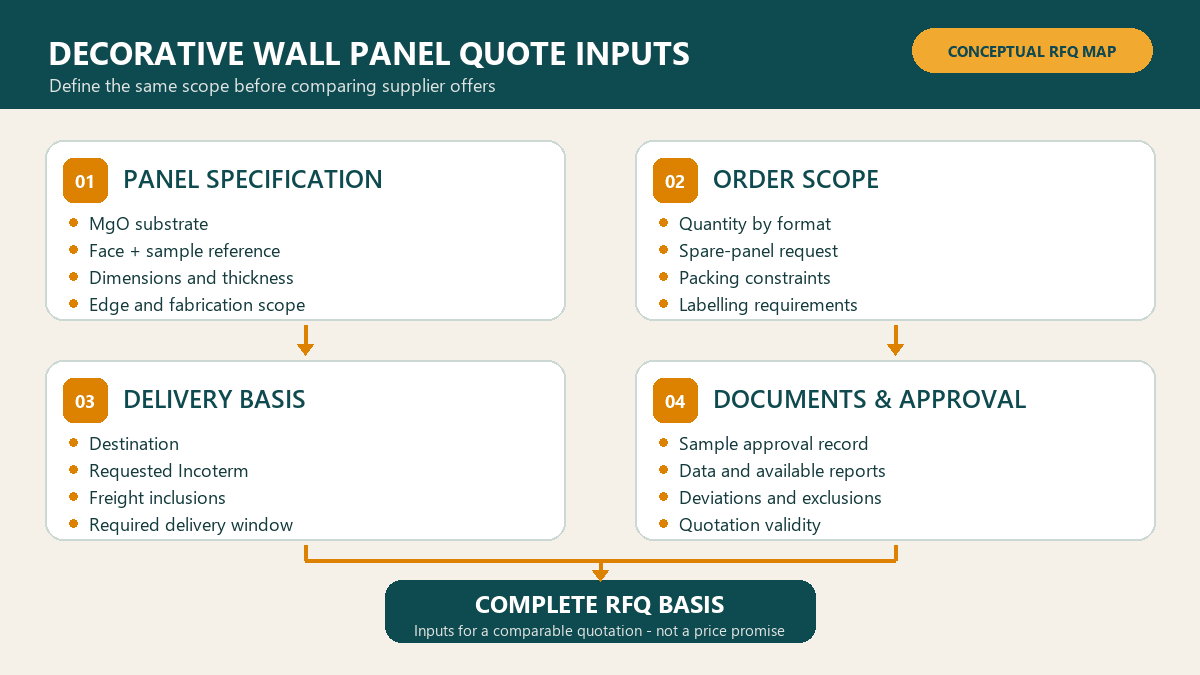
Searching for a decorative wall panels price can look straightforward, but two quotations may describe different products and different commercial scopes. A useful comparison starts with a defined panel, quantity and delivery basis. This guide explains the information a buyer should send when requesting a project quotation. It does not publish a universal price because a figure without a matched specification can be misleading.
Why one decorative wall panel price does not fit every project
A decorative panel quotation is built from several connected decisions. The substrate, decorative face, dimensions, edge work, order quantity, packing method and destination can all change what the supplier is being asked to provide. If any of those fields are missing, the supplier may have to make assumptions. Those assumptions make quotations harder to compare.
For Sulfycor decorative panels, the product definition should identify a magnesium oxysulfate MgO substrate and either a melamine-paper or HPL face. A wood-grain, stone-look or metallic-effect description identifies a visual sample direction; it does not by itself define the substrate, face construction or finished-panel performance. Buyers should request the current sample and technical information for the exact proposed configuration.
Separate panel supply from installed wall cost
The first scope decision is whether the request covers factory-supplied panels or a complete installed wall. A panel supplier can quote the agreed finished panels and any specifically listed fabrication or packing. An installed-wall budget may also involve framing, fasteners, trims, joints, site handling, labor, access equipment, waste allowance and local taxes. These items depend on the wall design and project location, so they should not be silently bundled into a panel-only figure.
Panel supply scope
- Agreed substrate and decorative face
- Confirmed panel dimensions and edge condition
- Listed fabrication, labeling and packing
- Named delivery basis and destination
Items to budget separately
- Supporting wall construction and accessories
- Site labor, tools and access
- Local unloading, storage and handling
- Taxes, duties and project-specific approvals

Define the finished panel before asking for price
Start with the intended interior application and the panel construction. The MgO decorative wall panels overview explains Sulfycor’s decorative-panel route. For the substrate route, review the magnesium oxide wallboard page. For a specific faced-panel route, see the melamine-faced MgO decorative wall panel. The quotation request should still identify which construction is required rather than treating these pages as interchangeable products.
State the face type and requested appearance clearly. Melamine paper and HPL are different face specifications. A color name or image reference is useful for narrowing the appearance, but approval should rely on the current physical sample and the supplier’s current specification. If matching to another material matters, explain the viewing conditions and acceptable variation instead of assuming that a screen image is a production standard.
Also record the required substrate thickness, finished thickness and any relevant tolerance request. Do not infer the performance of a finished faced panel or a complete wall from information about the bare substrate alone. If the project requires a particular test report or compliance document, ask what is available for the exact product configuration and intended market.
Record dimensions and fabrication scope
Panel length and width affect material planning, packing and handling. Send dimensions in one unit system, identify whether they are nominal or finished sizes, and include a drawing when several formats are required. If the supplier is expected to cut panels, provide a cut list that identifies each piece and quantity.
Fabrication should be listed rather than implied. Examples include cut-to-size work, openings, holes, grooves, edge treatment, back labeling or protective film. The drawing should show locations and reference points. Complex site conditions may be better handled after the wall designer or installer confirms the final layout. A supplier quotation can only reflect the fabrication information supplied at the time of quoting.
State quantity, packing and delivery basis
Provide the quantity by panel size, thickness and finish. A mixed-finish order is different from one repeated configuration, even when the total area is similar. If the project is at an early stage, label the quantity as an estimate and explain when the final schedule will be available. Minimum order requirements can depend on the selected configuration and should be rechecked for the current inquiry.
Packing is part of the commercial scope. Tell the supplier about destination handling, labeling needs, pallet restrictions and any split-shipment requirement. Ask the quotation to state what packing is included. If replacement pieces or attic stock are needed, list them separately so that all suppliers respond to the same schedule.
Delivery terms also matter. Give the destination city and country, preferred port or receiving address, and the requested delivery basis. Confirm whether freight, insurance, duties, taxes and unloading are included or excluded. Lead time, payment terms and quotation validity should be confirmed in the supplier’s current written offer because they can change with configuration and commercial conditions.
Compare decorative wall panel quotations on the same basis
A lower-looking total is not automatically a lower comparable offer. Build a comparison sheet with one row for every required field. Check the substrate description, face type, finish reference, dimensions, thickness, fabrication, quantity, packing, delivery basis, destination and document scope. Mark any assumption or exclusion rather than filling it in from memory.
- Product basis: same substrate, face and approved appearance reference.
- Quantity basis: same panel schedule and treatment of spare pieces.
- Processing basis: same drawings, cuts, openings and edge work.
- Logistics basis: same packing requirement, destination and delivery term.
- Documentation basis: same requested samples, data and available reports for the proposed configuration.
If one offer substitutes a face material, changes a dimension or excludes freight, keep it as an alternative rather than comparing it directly with the requested basis. Ask the decorative wall panel supplier to identify deviations in writing. This makes later design and purchasing decisions easier to audit.
Use this request-for-quotation checklist
- Project name, interior application and destination market
- Magnesium oxysulfate MgO substrate requirement
- Melamine-paper or HPL face and sample reference
- Panel length, width, thickness and quantity by finish
- Drawings for cuts, holes, grooves or edge treatment
- Packing, labeling, spare-panel and handling requirements
- Destination and requested delivery basis
- Required product data or reports for the exact proposed configuration
- Requested timing and any project milestone that affects the offer
Sending this information does not force the project into a final purchase specification. It gives the supplier a clear basis for questions and alternatives. When a field is undecided, label it as open and ask for the available options instead of asking for a single unsupported figure.
Frequently asked questions
Can I request a price using only the wall area?
Wall area is useful for early quantity planning, but it does not define the finished panel, layout, fabrication, waste, packing or delivery scope. Send the wall area together with the known specification fields and mark the remaining decisions as open.
Should panel supply and installation be compared in one line?
Keep them separate unless every quotation includes the same documented wall and installation scope. Panel supply is only one part of an installed-wall budget.
Does a wood-grain or stone-look name define the product?
No. It describes an appearance direction. The request should also identify the substrate, face material, dimensions, thickness and current sample reference.
How should I handle a required test or approval?
Name the requirement, intended market and exact product configuration. Ask the supplier what current documentation is available and have the relevant project professional determine whether it is suitable. Do not transfer a bare-board result to a faced panel or complete wall without matched evidence.
Request a project quotation
Send the application, panel size, thickness, finish, quantity and destination. Sulfycor can then review the request, identify missing inputs and prepare a quotation basis for the proposed decorative panel configuration.