


31 May Why MgO Boards Are the Superior Choice for Wall Sheathing
You want wall sheathing that can handle fire, water, and time. MgO Boards Use for Sheathing Materials gives you the best protection. These boards can resist fire up to 1200°F. They stay strong even when they get wet. They do not get weak like plywood or OSB. Look at this quick comparison:
Feature | MgO Boards | OSB Boards |
|---|---|---|
Fire Resistance | Non-combustible | Flammable |
Moisture Resistance | Water, mold, mildew resistant | Prone to swelling and mold |
Durability | Impact-resistant | Weakens in moisture |
Eco-Friendliness | Recyclable, sustainable | Deforestation concerns |
Cost | Higher upfront, better value | Lower upfront, higher maintenance |
You get walls that are safer and last longer. You also get a healthier place to live. MgO boards give you real value where it matters most.
Key Takeaways
MgO boards stop fire and water, so your walls stay safe. These boards last longer than other wall materials. This means you spend less money fixing or replacing them. MgO sheathing is good for the environment. It is made from natural minerals and helps keep the air inside clean. You need the right tools and skills to install it. But the benefits last a long time and are worth it. Using MgO boards gives you safer and stronger walls. This also makes your property worth more.
What Are Magnesium Oxide Boards?
 MgO Boards Use for Sheathing Materials
 MgO Boards Use for Sheathing Materials
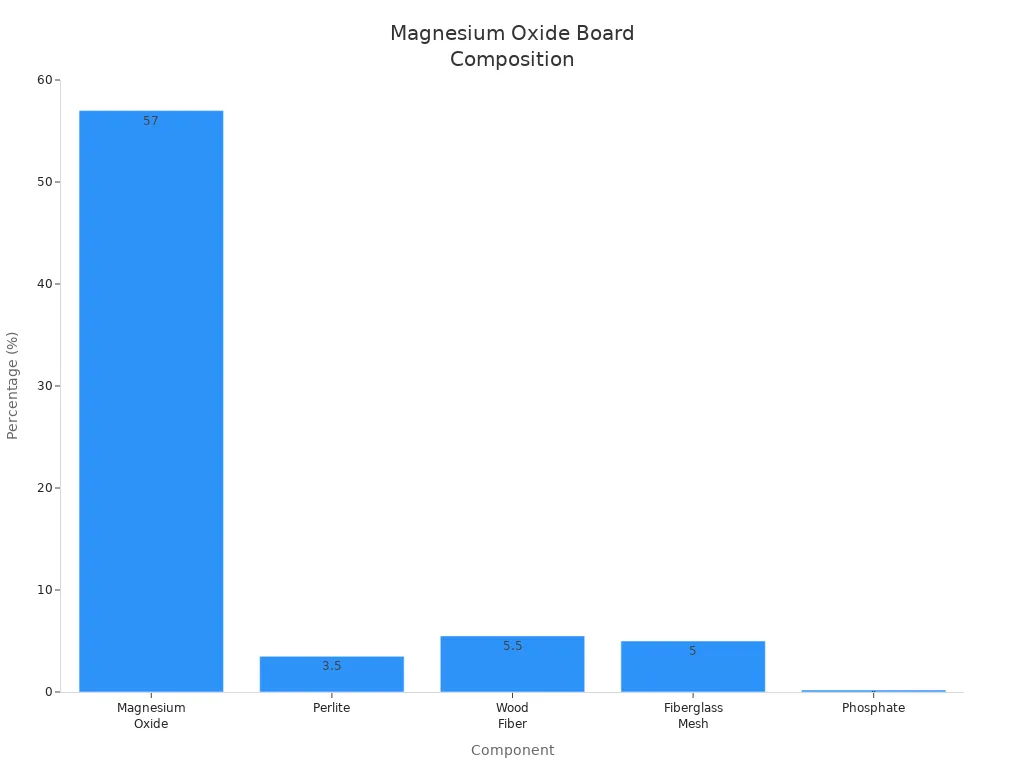
You want walls that are strong and last long. MgO board helps make this happen. These boards are made with a mix of special materials. The main part is magnesium oxide. It gives the board strength and helps stop fires. Other things like perlite, wood fiber, and glass mesh are added. Perlite makes the board lighter and keeps heat in. Wood fiber makes the board bend without breaking. Glass mesh helps the board stay tough and last longer. Here is what each part does in an MgO board:
Component | Role in Performance |
|---|---|
Magnesium Oxide (MgO) | Strength, fire resistance |
Magnesium Chloride | Binds materials together |
Perlite | Insulation, lighter weight |
Wood Fiber | Flexibility, extra strength |
Glass Mesh | Reinforcement, durability |
You can use MgO boards in many places. They work in kitchens, bathrooms, laundry rooms, and outside walls. These boards keep water, mold, and fire away from your home. MgO sheathing keeps walls strong where other walls might break.
Comparison to Traditional Sheathing
MgO board gives you more than wood or gypsum. Old walls made from plywood or drywall soak up water. They can swell and grow mold. MgO boards do not let much water in. They only take in 0.34% of water on the surface. Drywall takes in 3%. This means MgO sheathing is much better at keeping water out.
Material Type | Mold Resistance | Reason for Resistance |
|---|---|---|
Magnesium Oxide Boards | High | Inorganic minerals, no organic matter |
Plywood | Low | Contains cellulose and lignin |
MgO board also stands up to fire. It can protect your home for up to four hours. Gypsum only lasts 30 to 60 minutes. MgO boards stay strong in bad weather. They do not bend or crack like old walls. You get walls that last longer, keep you safe, and save money.
Pick MgO sheathing for your next job. You will notice how strong, safe, and valuable it is.
Fire Resistance and Safety Performance
MgO Sheathing Fire Ratings
You want walls that keep you safe in a fire. MgO sheathing can handle very high heat. Magnesium oxide boards do not burn or make smoke, even at 1436°F. Some tests show MgO sheathing stays strong for four hours at 2192°F. This is much better than plywood or OSB.
See how different boards work in fire:
Material | Notes on Fire Resistance | |
|---|---|---|
Magnesium Oxide Boards | Highly fire-resistant, better than gypsum or fiber cement | |
OSB | Not fire-resistant | Ignites easily under high temperatures |
Plywood | Low fire resistance | Burns quickly without special treatment |
MgO sheathing passes hard fire tests like ASTM E136 and EN 13501-1. These tests show magnesium oxide boards do not burn. You get walls that will not help a fire grow. You also feel safe, knowing your home has strong protection.
Test Description | Temperature Tolerance |
|---|---|
Maximum temperature without burning | 1436°F |
Fire rating in proper setups | Four hours at 2192°F |
ASTM E136 test results | Passes at 750°C for 30 min |
MgO sheathing must meet strict rules before you use it. ICC-ES labs check MgO for fire safety, strength, and water resistance. Important tests include ASTM E84, ASTM E119, and EN 13501-1+A1:2010. You can trust magnesium oxide boards to work when you need them.
Escape Time and Building Safety
When a fire starts, you need time to get out. MgO sheathing gives you more time to escape safely. Magnesium oxide boards slow down fire. They do not burn or make dangerous smoke. This helps you see and breathe better in an emergency.
Feature | MgO Boards | Traditional Materials |
|---|---|---|
Combustibility | Non-combustible | Combustible |
Fire Resistance | High | Lower |
Smoke Emission | Minimal | Harmful substances |
Evacuation Time | More escape time | Less escape time |
You want your family or workers to have enough time to leave. MgO sheathing can resist fire for one to four hours. This gives everyone time to get out safely. Clear air and strong walls help you find exits and stay calm.
Magnesium oxide boards make almost no smoke or toxic gas.
Clear air helps you see exits and escape routes.
MgO sheathing gives up to four hours for safe evacuation.
You can see these benefits in real buildings. Tall towers use MgO sheathing as a fire barrier. Commercial and industrial buildings use magnesium oxide boards for fire and water safety. Homeowners pick MgO sheathing to keep their families safe and homes strong.
Pick MgO sheathing for your next project. You will get great fire protection, more time to escape, and a safer place to live or work.
Moisture, Mold, and Durability
Moisture Protection of Magnesium Oxide Sheathing Panels
 Moisture Protection of Magnesium Oxide Sheathing Panels
You want walls that stay strong when they get wet. Magnesium oxide sheathing panels protect your walls from water. These panels keep their shape after getting wet. You do not have to worry about swelling or bending. Tests show magnesium oxide boards absorb only a tiny bit of water. Plywood and gypsum panels soak up more water and lose strength. MgO sheathing keeps your home safe in humid places or heavy rain.
Property / Material | Magnesium Oxide (MgO) Board | Plywood | Drywall (Gypsum Panels) |
|---|---|---|---|
Moisture Absorption | Higher | Higher |
MgO sheathing panels resist water and keep your walls safe. These panels do not break down or rot. MgO sheathing works well in kitchens, bathrooms, and basements. You can use magnesium oxide sheathing panels inside or outside. These panels protect against moisture for many years.
Mold, Rot, and Longevity
You want panels that stop mold and rot. Magnesium oxide boards resist mold better than wood and gypsum. MgO sheathing does not feed mold because it is made from minerals. You do not need to fix or replace them often. These panels stay strong and look good for a long time.
MgO panels resist moisture and do not rot like wood.
They stay strong without needing lots of repairs.
MgO boards are better for the environment than wood.
Feature | Magnesium Oxide Boards | Traditional Materials |
|---|---|---|
Water Absorption Rate | <10% | >20% |
ASTM G21 Mold Resistance Score | 0/0/0 | N/A |
Strength Retention After Moisture Exposure | Maintains most strength | Loses up to 52% |
Magnesium oxide sheathing panels last in all kinds of weather. These panels do not bend or shrink. MgO sheathing stands up to bad weather and high humidity. You can trust magnesium oxide boards to last a long time. These panels keep your home safe and strong year after year.
Pick MgO sheathing for your next project. You will get moisture protection, mold resistance, and panels that last.
Structural Strength and Environmental Impact
Performance in Cladding and Support
You want walls that stay strong all the time. MgO sheathing gives your walls extra strength and support for cladding. Magnesium oxide boards are tough and can handle impacts, water, and heavy things. These boards do not bend, swell, or crack when the weather changes. They keep their shape and strength year after year.
Look at how MgO sheathing compares to other materials:
Material | Impact Resistance (KJ/m²) | Flexural Strength (MPa) | Shear Stress (psf) | Strength Loss After Wetting-Drying Cycles (%) |
|---|---|---|---|---|
Magnesium Oxide Sheathing | > 5 | 15 – 22 | > 280 | 0 |
Plywood | Decent | N/A | N/A | 9 |
Gypsum Board | N/A | N/A | N/A | 36 – 52 |
OSB | N/A | N/A | N/A | 40 |
MgO sheathing keeps its strength even after getting wet and drying out. It does not lose its good qualities like plywood or gypsum. MgO boards take in water but let it go without getting weak. They can handle heavy loads and hits, so they are great for cladding and support.
MgO sheathing stays strong in tough weather.
Magnesium oxide boards do not break or bend easily.
You get walls that last and protect your building.
Eco-Friendliness and Health
You want to help the planet and stay healthy. MgO sheathing is good for the environment and your health. Magnesium oxide boards use natural minerals and do not have harmful chemicals. Making these boards uses less energy, so there is less pollution.
Certification/Standard | Description |
|---|---|
ICC-ES | Confirms compliance with IBC and IRC standards. |
ASTM E119 and E135 | Ensures fire safety and non-combustibility. |
ISO-certified | Guarantees quality and environmental compliance. |
MgO sheathing helps you build in a green way. These boards meet important standards like LEED, BREEAM, and WELL. They even trap CO₂ during curing, holding up to 40% of their own emissions. You help the earth every time you use MgO sheathing.
Magnesium oxide boards make indoor air better.
They do not release VOCs or allergens.
You can install MgO sheathing safely without special masks.
These boards stop mold and make almost no smoke in a fire.
You get health and environmental benefits with every panel. MgO sheathing keeps your space safe, clean, and green. Pick MgO sheathing for a strong, healthy, and eco-friendly building.
Cost, Installation, and Value
Upfront and Lifecycle Costs
 Upfront and Lifecycle Costs
You want to know if MgO sheathing gives you real value. The upfront cost for MgO sheathing is higher than plywood or drywall. You pay more at first, but you save money over time. MgO sheathing lasts longer and needs less repair. You do not have to worry about water damage, mold, or fire. This means you spend less on fixing your walls.
Material | Material Cost per sq.ft. | Installation Labor Cost per sq.ft. |
|---|---|---|
MgO board | $1.50 – $3.50 | $3.00 – $8.00 |
Drywall | $0.30 – $1.00 | Lower |
Plywood | $0.80 – $2.50 | Moderate |
MgO sheathing costs more than drywall and plywood.
You pay between $1.50 and $3.50 per square foot for MgO sheathing.
Skilled labor is needed for installation, which increases the cost.
You save money in the long run because MgO sheathing resists water, fire, and mold.
MgO sheathing gives you lower maintenance costs. You do not need to replace panels often. You avoid expensive repairs in wet areas. The durability of MgO sheathing means your walls stay strong for years.
Installation and Maintenance
You want installation to be easy and fast. MgO sheathing needs proper surface preparation. The wall must be clean and dry. You use carbide-tipped blades to cut MgO sheathing because it is dense. You attach MgO sheathing with corrosion-resistant screws or nails. Builders may need training to install MgO sheathing correctly.
Installation Requirement/Challenge | Description |
|---|---|
Proper Surface Preparation | The wall structure must be clean, dry, and free from contaminants for optimal adhesion. |
Specialized Cutting Tools | MgO boards require carbide-tipped blades for cutting due to their density. |
Specific Fastening Techniques | Use corrosion-resistant screws or nails for secure attachment. |
Installation Learning Curve | Builders may need training to install MgO boards correctly. |
MgO sheathing is less known than traditional sheathing.
Quality can vary, so you must choose good MgO sheathing.
MgO sheathing may not be available everywhere, which can delay your project.
You spend less time and money on maintenance. MgO sheathing resists water and mold. You do not need to fix or replace panels often. MgO sheathing works best in wet areas and keeps your walls safe.
Choose MgO sheathing for your next project. You get strong walls, less maintenance, and better value over time.
You want the best for your walls. Magnesium oxide boards give you unmatched fire safety, moisture protection, and lasting strength. They do not burn or get moldy. They keep their shape in wet weather. You also help the planet because these boards capture CO₂ and do not release harmful chemicals.
Why choose MgO boards?
Superior fire and mold resistance
Stronger impact and fastener strength than traditional materials
Better soundproofing and insulation
You deserve walls that last. Pick MgO boards for your next project and build with confidence.
FAQ
What makes MgO boards better than plywood or drywall?
You get stronger walls with MgO boards. They resist fire, water, and mold. Plywood and drywall cannot match this protection. MgO boards last longer and keep your home safer.
Can I use MgO boards outside?
Yes! You can use MgO boards for exterior walls, soffits, and even siding. They stand up to rain, snow, and sun. You get reliable performance in any climate.
Are MgO boards safe for indoor air quality?
Absolutely. MgO boards do not release harmful chemicals or VOCs. You breathe cleaner air. Your family stays healthier.
How do I cut and install MgO boards?
Use a carbide-tipped saw blade for cutting. Fasten the boards with corrosion-resistant screws. You may need some training, but you will get strong, secure walls.
Do MgO boards cost more than regular sheathing?
MgO boards cost more upfront. You save money over time because you avoid repairs and replacements. You invest once and enjoy lasting value.