

08 Aug Cement Board Fire Rating: What the Tests Really Mean
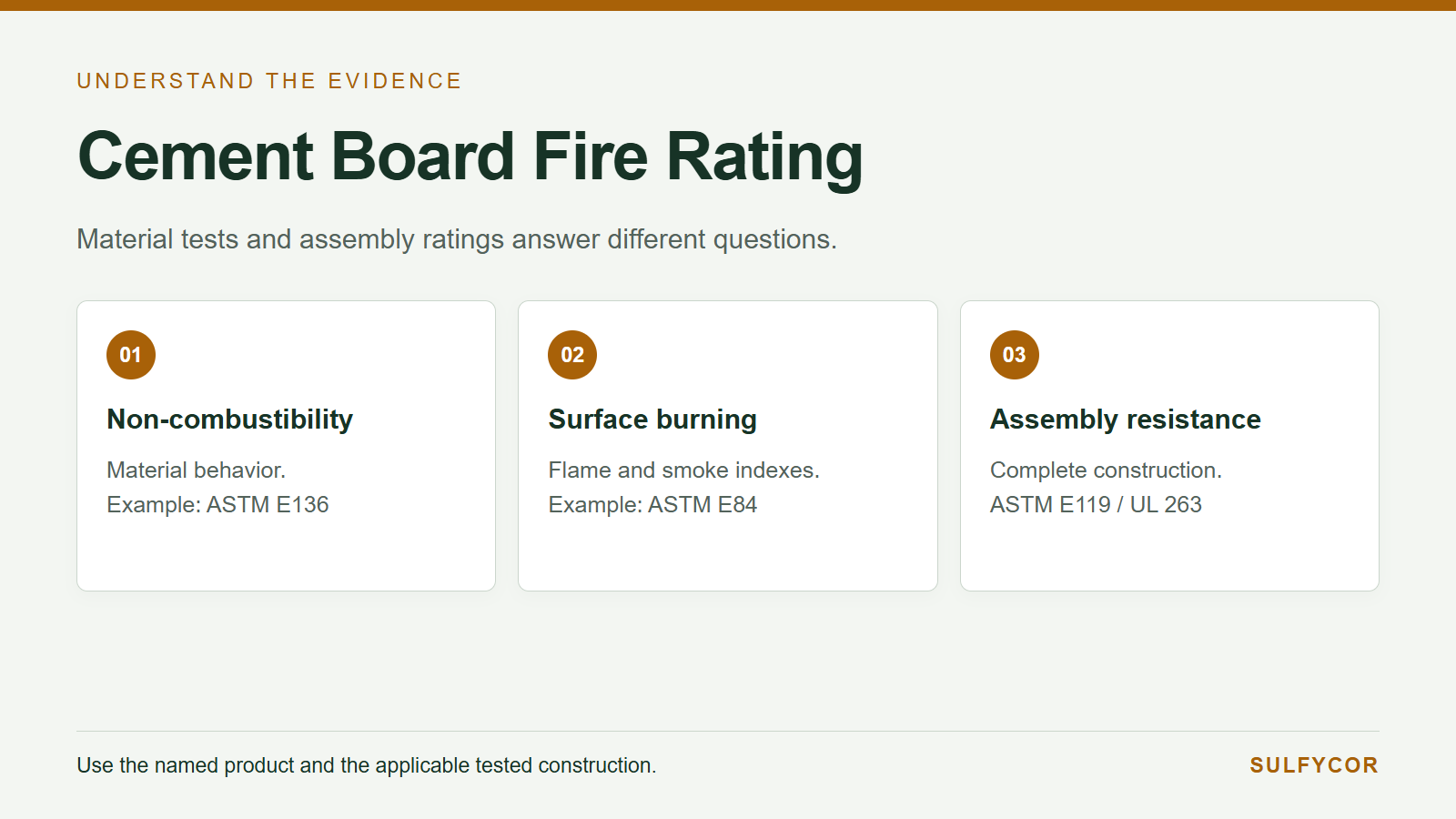
Cement board does not have one universal fire rating. A named product may have non-combustibility or surface-burning results, while an hourly fire-resistance rating belongs to a specified wall, floor, ceiling or other tested construction. Board thickness alone does not establish a one- or two-hour rating.
Start by identifying which evidence the project requires. For a broader material-selection comparison covering moisture, strength, installation and cost, see MgO board vs cement board.
Updated 25 November 2026. This guide explains how to read product and assembly evidence; it does not assign ratings to untested constructions.
What does “cement board fire rating” mean?
The term is often used for different tests. A result describing the material’s burning behavior is different from a rating describing how a constructed wall or floor performs during fire exposure.
| Evidence | What it addresses | What it does not establish |
|---|---|---|
| Non-combustibility, such as ASTM E136 | The behavior of the submitted material under the specified test. | An hourly wall, floor or ceiling rating. |
| Surface burning, such as ASTM E84 | Flame-spread and smoke-developed indexes. | By itself, an hourly rating or a non-combustibility classification. |
| Assembly fire resistance, such as ASTM E119 / UL 263 | The specified construction’s performance under the applicable test criteria. | Permission to substitute any board with a similar name or thickness. |
UL explains that fire-resistance ratings apply to complete assemblies and their specified components. ASTM describes E84 as a surface-burning comparison with defined limitations. Sources: UL component-identification guidance and ASTM E84 scope.
Is cement board non-combustible?
Check the named product’s documentation. “Cement board” covers different products and constructions, so a statement about one manufacturer’s board should not be applied to every panel in the category.
James Hardie states that Hardie Backer boards are recognized as non-combustible when tested to ASTM E136. Its product information also describes a particular 1/4-inch board as a component of a one-hour construction when installed under the referenced evaluation. The construction and installation conditions are part of that claim; it is not a one-hour rating for every loose sheet.
Also identify the panel variant and any coatings, facings, adhesives or finishes. They should be permitted by the relevant product or assembly documentation.
Can cement board provide a one- or two-hour fire rating?
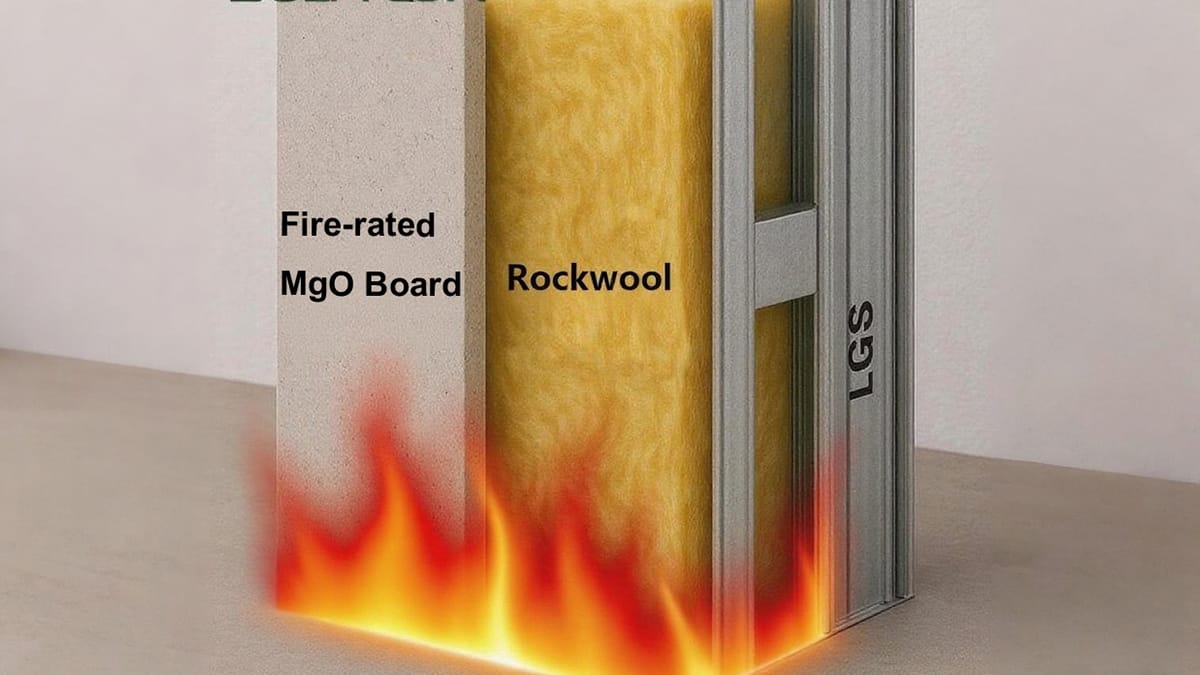 A cement board can be a component of a rated construction where the applicable design permits it. Obtain the actual design or evaluation showing the required rating, product and construction details. There is no dependable generic table assigning hours to every board thickness.
Read the design for the complete system, including the board designation, layers, framing, insulation, fasteners, joints, supports and exposure conditions. A stated wall rating is not automatically a ceiling or floor rating.
Use UL’s guidance on finding certified fire-rated designs to locate and interpret the relevant listing. Avoid copying a design number from a different sheathing product and treating it as a generic cement-board specification.
What should you check in a fire-rated design?
- Construction type and exposure: confirm whether it is a wall, floor, ceiling or another system, and the direction of fire exposure.
- Named product: match the board manufacturer, designation, thickness and number of layers.
- Support and fixing: follow the specified framing, fastener type, spacing and edge details.
- Other components: check insulation, joints, finishes and any other required layers.
- Openings and penetrations: confirm their required protection through the relevant design and project documentation.
- Permitted variations: use only changes supported by the design, listing guidance or the appropriate project review.
UL’s guidance for mineral and fiber board fire-protection products highlights limitations involving exterior use, thickness changes and substitutions. More board thickness is not automatic permission to depart from the tested construction.
Is cement board fireproof?
“Fireproof” is too broad to replace a test result or design specification. Non-combustibility describes one aspect of a material’s behavior; it does not prove that heat cannot pass through a panel or that the surrounding construction will remain effective indefinitely.
Use the documented classification or assembly rating that the project requires. Do not convert a marketing description, a temperature claim or a surface flame-spread result into a number of fire-resistance hours.
Can cement board be used behind a stove or fireplace?
Only as permitted by the appliance instructions, the chosen protection system and applicable project requirements. Adding cement board does not automatically reduce the clearance to combustible materials behind it.
Confirm the appliance’s required clearances, approved wall-protection arrangement, supports, air spaces where specified, fixings and finishes. A generic board fire result is not an appliance installation instruction.
Does cement board resist fire better than drywall or MgO board?
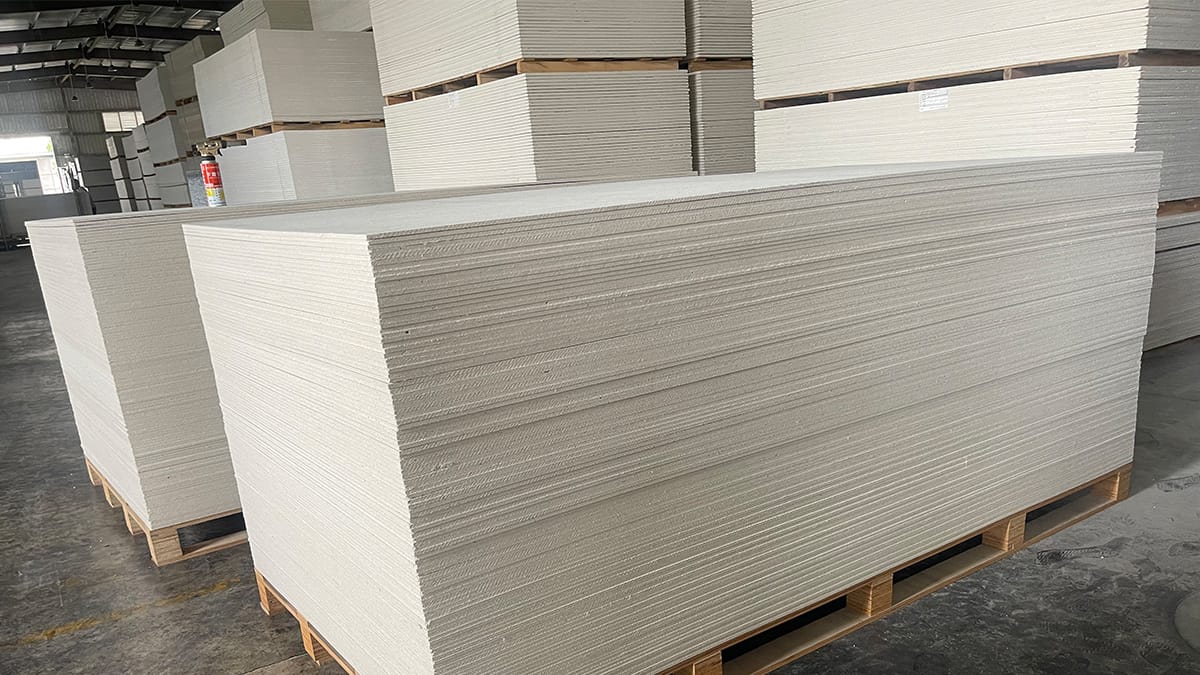 There is no sound universal ranking of “MgO first, cement board second, drywall third.” Compare named products and, where an hourly rating is needed, equivalent complete constructions. A suitable gypsum-board assembly may have a documented rating that cannot be inferred from the behavior of an individual material.
MgO sample reports can include reaction-to-fire, surface-burning and non-combustibility results. These are useful, but they do not establish an hourly rating for an unspecified assembly. See the Sulfycor fire report library for identified reports.
For full selection criteria beyond fire, use the MgO board vs cement board comparison. Consider the location, moisture, loads, installation, approvals and cost alongside fire performance.
What installation or maintenance changes can affect the rating?
Missing layers, incorrect fixings, unprotected penetrations or unsupported substitutions can depart from the rated construction. Inspect the finished work against the relevant design, and have damage or later alterations assessed before assuming the original rating still applies.
Follow the manufacturer’s instructions and the inspection requirements applicable to the building. A generic repainting interval or annual board check is not evidence that an assembly retains its fire rating.
Frequently asked questions
Does Class A mean a one-hour fire rating?
No. A surface-burning classification is not an hourly assembly rating. Confirm which test and classification the product documentation actually reports.
Does thicker cement board always give more rated time?
No universal rule converts thickness into hours. Use the thickness and layer arrangement specified in an applicable rated design.
Can I substitute cement board for gypsum board in a UL design?
Do not assume so. A substitute must be permitted by the relevant listing or supported through the appropriate review. Similar material descriptions do not establish equivalence.
What should I request from a supplier?
Request the product data, relevant test or listing information, design reference and installation instructions. Match the exact product and proposed construction to the project requirements.
Sources and further reading
This guide uses the linked ASTM scope, UL explanations and manufacturer-specific product documentation. Those references serve different purposes and do not create a new approval for an untested construction.
Continue with MgO board vs cement board for material selection, or Sulfycor technical documents for available MgO sample reports.