


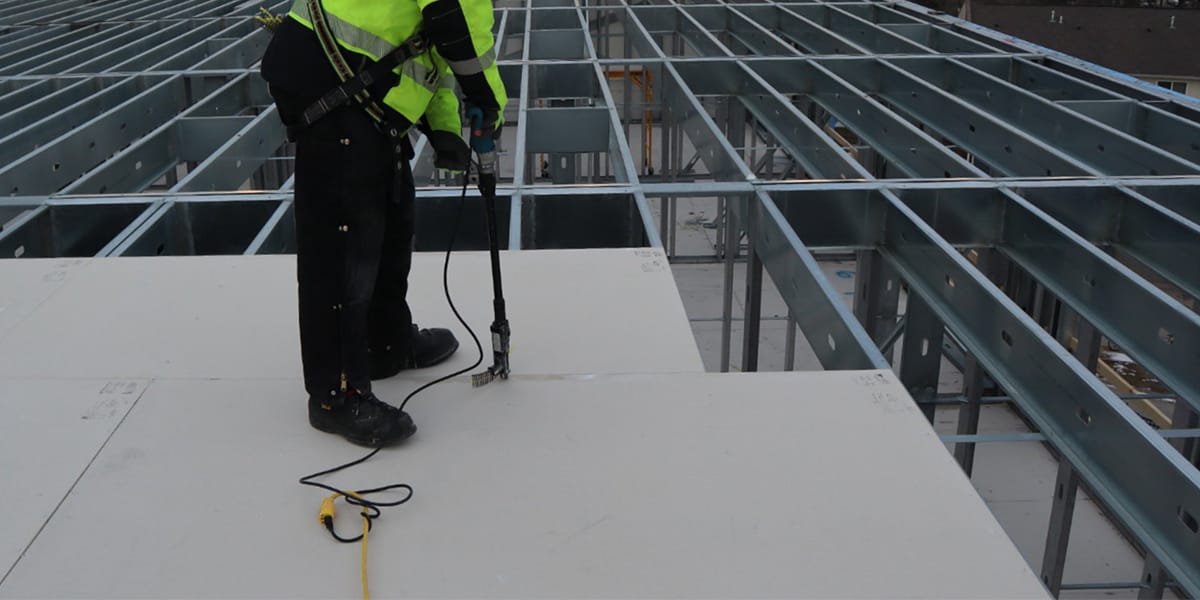
24 Jul Moisture-Resistant Subfloor Selection for Commercial Projects
A “waterproof subfloor material” should not be selected by label alone. In commercial, modular and multifamily projects, the subfloor must meet structural requirements while the complete floor assembly manages liquid water, vapor, joints, drains, penetrations and drying. A water-resistant panel is not automatically the waterproofing layer.
This guide provides a professional selection workflow. For a material-by-material comparison, see Water-Resistant Subfloor Materials: Specifier Guide.
Step 1: classify the moisture exposure
| Exposure | Examples | Primary design response | Subfloor question |
|---|---|---|---|
| Dry interior | Offices, guestrooms, dry retail and corridors | Control normal construction moisture and service leaks | Does the panel meet structure, finish and ordinary humidity requirements? |
| Temporary construction wetting | Open modules, roofs or floors before enclosure | Storage, protection, permitted exposure, inspection and drying plan | What exposure is permitted for the exact product and edge condition? |
| Intermittent splash or spills | Washrooms, kitchens, laundry and service zones | Durable finish, sealed interfaces and leak response | How do joints, penetrations and adjacent materials respond? |
| Direct-wet floor | Showers, washdown and some food-service areas | Designed waterproofing, slopes, drains and transitions | Is the panel an approved substrate for the selected waterproofing system? |
| High humidity/vapor | Basements, pools, humid climates and process spaces | Condensation, insulation, air/vapor control and drying analysis | What are moisture movement and finish compatibility limits? |
| Exterior/flood exposure | Decks, open structures or flood-resilient construction | Project-specific drainage, weathering, corrosion and recovery design | Is exterior or flood use explicitly documented? |
Step 2: define who provides waterproofing
The drawings should identify the water-control layer. It may be a sheet or liquid membrane, a proprietary tray/system, a coating, an integrated panel system or another approved assembly. Define how it connects to drains, walls, curbs, columns, pipes, doorways and movement joints.
If a supplier calls the board waterproof, ask whether the claim covers cut edges, fastener penetrations, joints and long-term installed service. A panel-level test does not establish that the completed floor is watertight.
Step 3: establish structural requirements
Record framing material, support spacing, spans, design loads, concentrated loads, partitions, equipment and deflection criteria. Identify whether the panel is structural subfloor, nonstructural underlayment or tile backer.
Specify grade/span rating for recognized wood structural panels or exact engineering values for alternative boards. Check machine and cross-machine direction, thickness, edge support, orientation, joints and fastening. Do not use water resistance as a substitute for structural evidence.
Step 4: coordinate the finished floor
- Tile: verify deflection, backer, membrane, mortar, tile size/weight, grout and movement joints.
- Resilient flooring: verify moisture, flatness, joints, underlayment, primer and adhesive limits.
- Wood/laminate: coordinate panel moisture, vapor, underlayment and fastening or floating installation.
- Resinous systems: confirm substrate preparation, moisture testing, movement, cracks and chemical exposure.
- Carpet: address moisture, seams, transitions, cleaning and future access.
Step 5: compare candidate panels on the same basis
Shortlist products only after exposure, structure and finish are defined. Compare:
- Exact manufacturer, SKU, thickness, dimensions and edge profile
- Structural or nonstructural role and applicable engineering data
- Water absorption, dimensional movement, cyclic wetting and drying evidence where relevant
- Permitted construction and service exposure
- Fastener type, corrosion compatibility and schedule
- Joint, perimeter and penetration treatment
- Membrane, primer, adhesive, mortar and finish compatibility
- Fire and acoustic assembly requirements
- Weight, breakage, cutting, dust, labor, waste and installed cost
Material roles in a moisture-control assembly
| Material | Possible role | Moisture caution |
|---|---|---|
| Plywood/OSB | Structural subfloor | Specify grade/exposure and control wetting, edges and drying |
| Cementitious backer | Tile substrate over structural floor | Moisture tolerance does not automatically provide waterproofing |
| Gypsum-based panel | Specialized underlayment/subfloor component | Use only within exact product and assembly limits |
| MgO/MgSO4 board | Structural or nonstructural floor component when documented | Formulation and SKU vary; verify movement, exposure, fasteners and finish compatibility |
| Concrete | Structural slab/base | Moisture vapor can affect adhesives and finishes |
Step 6: verify test and product evidence
Request the full report when a critical claim depends on testing. Match manufacturer, plant, product/SKU, thickness, reinforcement, surface, specimen conditioning, test method, laboratory, report number, date, result and limitations.
A water-absorption percentage alone does not establish structural capacity, dimensional stability, waterproofing or long-term exterior durability. A result for one thickness or formulation should not be applied to every panel in a product family.
Step 7: design joints, penetrations and drying
Many failures occur at interfaces rather than in the middle of a board. Detail supported joints, tongue-and-groove edges, perimeter gaps, movement joints, drains, pipes, columns, doorways and transitions to walls.
Define how wet assemblies are inspected and dried before finishes are installed. Avoid trapping moisture between low-permeance layers without a project-specific analysis.
MgO and magnesium sulfate subfloor review
MgO subfloor boards may be considered for professional floor systems when the exact product and thickness are documented for the required duty. Review formulation, reinforcement, density, direction, edges, structural data, fastener behavior, movement, exposure and finish compatibility.
Sulfycor’s internal test summary lists moisture-related entries but does not identify a laboratory, report number, specimen/SKU, thickness or date. Those values are not used here to label a product waterproof. Project teams should request the underlying report for the offered board.
Commercial subfloor submittal checklist
- Project jurisdiction, building type and room/exposure classification
- Framing, spacing, spans, loads, deflection and panel role
- Waterproofing, drainage, vapor/air control and drying strategy
- Finished floor and compatible membrane, mortar, primer or adhesive
- Exact panel/SKU, thickness, dimensions, edges and quantity
- Fasteners, joints, penetrations, perimeter and movement details
- Required structural, moisture, fire and acoustic evidence
- Storage, installation sequence, inspection, packaging and destination
Frequently asked questions
What is the best waterproof subfloor material?
There is no universal best. Select a structurally suitable panel and a complete moisture-control/waterproofing system for the actual exposure and finish.
Is water-resistant the same as waterproof?
No. Water resistance is bounded product performance. Waterproofing requires a continuous system, including joints, penetrations, drains and transitions.
Can cement board replace structural subflooring?
Many cement backer boards are installed over a structural subfloor. Use one structurally only when the exact product and design permit it.
Can MgO board be used in wet commercial areas?
An exact MgO/MgSO4 product may be evaluated as a floor component or substrate when exposure, waterproofing, structure, fasteners, joints and finishes are documented.
Request a project-specific subfloor selection
Send Sulfycor your floor build-up, framing, loads, exposure, waterproofing, finish, required standards, quantity and destination. We can identify relevant magnesium board products and provide available samples, technical documents and quotation inputs.