

20 May Water-Resistant Wall Panels: Materials, Benefits and Decorative Finish Limits
When a project team searches for waterproof decorative wall panels, the first task is to define what “waterproof” is expected to mean. Occasional cleaning, kitchen splashes, condensation and continuously wet exposure are different conditions. A product description alone cannot show that one panel is suitable for all of them.
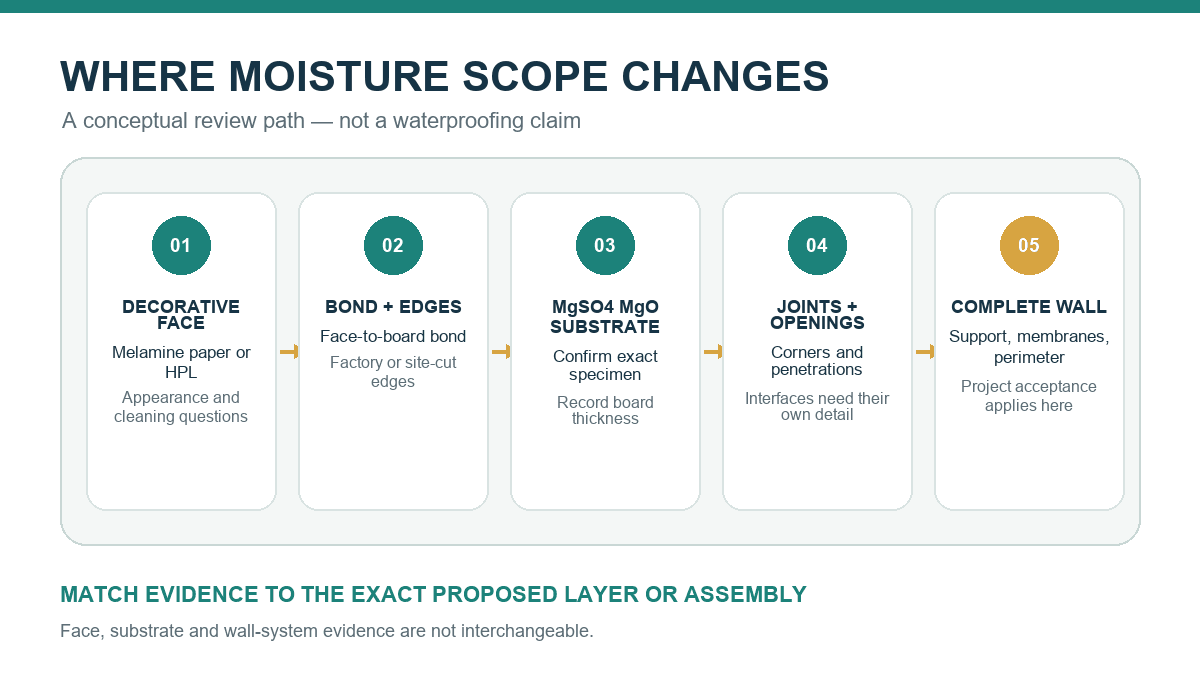
Sulfycor decorative panels use a magnesium oxysulfate MgO substrate with a melamine-paper or HPL face for interior and modular-house wall applications. The face, substrate, bond, exposed edges, joints and complete wall build-up have different roles. This guide shows how to evaluate those roles and the supporting documents without treating a panel as a complete waterproofing system.
Specification rule: match every moisture-related statement to the exact specimen, exposure, test method and acceptance criterion. A result for bare board does not automatically apply to a faced panel or an installed wall.
Water-Resistant and Waterproof Are Not Interchangeable
Water resistance describes a limited response under stated conditions. To evaluate it, a buyer needs to know what was exposed, how it was tested, for how long and what counted as an acceptable result. “Waterproof” is a broader claim. In a construction specification, it should not be assumed without evidence for the proposed product or assembly.
The room name does not settle the question. Searches for “waterproof laminate wall panels” can mix a surface category with a complete-wall claim, while “decorative wall panels for kitchen” does not define the exposure. A kitchen panel may face only periodic wiping in one location and repeated direct splashes in another. Bathrooms can include dry walls, splash zones and areas that require a separately specified wet-area system. Record the actual exposure before selecting a panel.
Separate the Face, Substrate and Wall Assembly
A finished decorative panel is more than its core board. The following layers and details should be reviewed separately:
- Decorative face: the specified melamine paper or HPL surface.
- Substrate: the magnesium oxysulfate MgO board beneath the face.
- Bond: the connection between the decorative face and substrate.
- Edges: factory-finished, site-cut or otherwise exposed panel edges.
- Joints and penetrations: interfaces between panels and around services, openings and fixtures.
- Wall assembly: the support, cavity, adjacent membranes, trims, sealants and perimeter details.

A decorative face can change surface cleaning and appearance requirements, but its presence does not by itself establish the water performance of the bond, edge or wall. Likewise, a substrate report cannot establish the performance of every face or complete assembly.
Review the Sulfycor MgO decorative wall panel range for product context. For a closer comparison of the two face categories, see melamine-paper faced and HPL-faced MgO panels. Face choice should be confirmed against the supplied sample and project documents rather than a generic material ranking.
Read Moisture Evidence by Specimen Scope
A useful report review starts with the specimen description, not the headline claim. One available Sulfycor Intertek report identifies a supplied 12 mm Magnesium Sulfate Board / MGO board specimen. That identity is the boundary for using the report in this discussion. It is not a test of every thickness, a melamine-faced panel, an HPL-faced panel, the face-to-board bond, an edge detail or a complete wall.
Other reports for 6 mm and 10 mm boards name E-Smart / ProGeneus as the applicant. They should not be presented as evidence for the current Sulfycor finished decorative panel. This distinction matters because similar product names do not make specimens interchangeable.
Five questions for any report
- Who supplied the tested specimen?
- What exact product, thickness and finish does the report identify?
- Which test method and exposure conditions were used?
- What result and acceptance criterion are recorded?
- Does the proposed panel or wall match that specimen and scope?
If any answer is missing or does not match the proposed item, record the gap. The responsible project team can then request matched evidence, limit the intended use or select a different tested system.
Define the Expected Moisture Exposure
Before comparing water-resistant wall panels, describe the exposure in practical terms. Avoid relying on labels such as “wet area” or “water-repellent decorative panel” without a project definition.
- Will the surface receive occasional wiping, condensation, repeated splash or direct water?
- How often will it be cleaned, and which cleaning products require compatibility review?
- Are cut edges, joints or penetrations located inside the exposure zone?
- Is a membrane or another waterproofing component specified behind or next to the panel?
- Which authority, designer or contractor approves the complete wall detail?
- Which documented test method and acceptance criterion apply to the project?
These questions allow suppliers to respond to the same conditions. They also make it easier to see when one proposal addresses only the face while another addresses a tested assembly.
Check Bonds, Edges, Joints and Penetrations
Moisture can reach a wall through more than the visible face. A project review should cover the face-to-substrate bond, factory edges, site-cut edges, joints, corners, service penetrations and transitions to other materials. Each detail needs to match the selected panel and the intended exposure.
Do not copy a universal joint width, sealant, adhesive, fastener spacing or maintenance interval from an unrelated board guide. Obtain the approved details for the exact panel configuration and supporting wall. Where the project requires documented wet-area performance, evaluate the applicable product or complete assembly rather than assuming that a sealant turns a decorative panel into a waterproof wall.
Compare Proposals on a Like-for-Like Basis
A practical comparison sheet should put specimen identity and evidence next to the commercial description. Include the face category, MgO substrate thickness, panel dimensions, edge condition, intended exposure, referenced report and any wall-system dependency. Mark unsupported items as open questions instead of converting them into assumptions.
For broader context, the guide to interior decorative wall panel materials explains why the substrate, finish and project condition should be compared separately. Generic “best waterproof panel” lists can help identify categories, but they are not a substitute for evidence that matches the proposed product.
When a Different Wet-Area System Is Needed
If the expected exposure exceeds the documented scope, the safe specification decision is to stop and resolve the gap. The outcome may be a revised panel detail, additional project evidence or a different tested wet-area system. The decision belongs to the responsible project parties and should be recorded before procurement or installation.
Frequently Asked Questions
Are Sulfycor decorative MgO wall panels waterproof?
Do not use a universal waterproof claim. Sulfycor decorative panels combine a magnesium oxysulfate MgO substrate with a melamine-paper or HPL face, but suitability must be checked against the exact finished-panel configuration, exposure, evidence and wall detail.
Can a decorative panel be specified for a kitchen?
A kitchen label is not enough. Define the location, splash and cleaning conditions, then check the face, edges, joints, penetrations and supporting wall against the project requirements.
Does an HPL face make the complete wall waterproof?
No such conclusion should be drawn from the face name alone. The bond, substrate, edges, joints, penetrations and adjacent wall components remain part of the evaluation.
What should a buyer send for a scope review?
Send the room and exposure description, face type, substrate specification, thickness, sample or specimen reference, relevant test requirement, panel quantity, destination and project documentation needs.
Review the Proposed Panel Scope Before Sampling
Share the expected moisture exposure, panel face, substrate specification, quantity and destination. Sulfycor can review the proposed product scope and available documents before sampling or specification. Send the project details to Sulfycor.