


24 Mar Interior Decorative Wall Panel Materials: A Practical Comparison
Interior decorative wall panels are often compared by the material name printed on a catalogue. That is not enough for a project decision. A visible face, its substrate, the bonding construction, edges and joints may come from different specifications. Two panels with a similar woodgrain or stone-look appearance can therefore require different questions before approval.
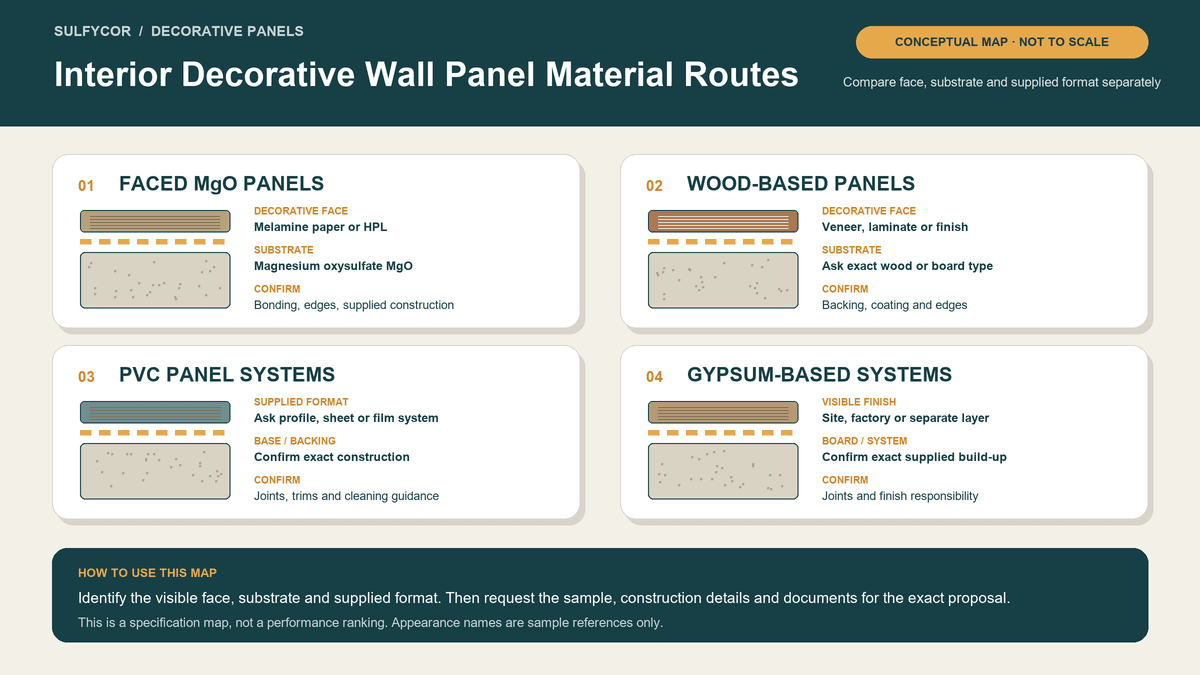
This guide compares four common material routes: faced magnesium oxysulfate MgO panels, wood-based decorative panels, PVC panel systems and gypsum-based finished systems. It does not name a universal winner. Instead, it shows which details to identify, which samples to approve and which documents to request for the actual product being offered.
Identify the decorative face, substrate and wall role
Start by describing the layer you can see and the layer that supports it. Then define how the supplied panel fits into the wall. A decorative lining, a structural sheathing board and a complete partition system do different jobs, even when they share a similar surface appearance.
- Decorative face: record the finish type, supplier code, colour, pattern, texture and included faces.
- Substrate: identify the board beneath the face rather than using a finish name as the whole material description.
- Bonding construction: ask how the face becomes part of the panel and which supplied configuration the documents describe.
- Edges and joints: state the visible edge condition, joint appearance, trims and coordination responsibility.
- Wall role: confirm whether the item is an interior lining, a board within a wall build-up or another clearly defined component.
Appearance words such as woodgrain, stone-look and metallic effect describe a sample. They do not mean that the panel is solid wood, stone or metal. Link the approved appearance to a sample or control reference rather than relying on a screen colour.

Compare common interior decorative wall panel routes
Faced magnesium oxysulfate MgO panels
Within the Sulfycor Decorative range, the substrate is magnesium oxysulfate MgO and the decorative face can be melamine paper or HPL. Keep those choices separate in the enquiry. The substrate identity does not, by itself, define the face, bonding layer, edges or finished wall system.
The MgO decorative wall panel range provides the product-family route. Ask for the offered panel size, substrate information, face reference, visible-edge proposal, packing method and documents that correspond to the quoted construction. If a report describes only a bare substrate, do not restate it as proof for every decorative face or complete wall.
Wood-based decorative panels
“Wood panel” can describe solid wood, veneer over a board, a laminated wood-based substrate or another manufactured construction. The appearance alone does not identify which one is being supplied. Record the substrate, veneer or decorative layer, finish system, backing, edge treatment and sample reference.
Project teams should also state the cleaning method, room conditions and any documentation they require. Use the product manufacturer’s current technical information for the selected construction. Do not transfer a result from one wood species, board type, coating or thickness to another option.
PVC panel systems
PVC is also a broad label. A quotation may refer to a solid profile, a hollow profile, a sheet, a film over another board or a system with its own joints and trims. Ask the supplier to identify the complete supplied format. Confirm the visible face, core or backing, joint detail, permitted cleaning method and replacement procedure for that format.
If the project has moisture, indoor-material, fire-related or maintenance requirements, list them as requirements and request evidence for the exact product and installation scope. The letters “PVC” do not answer those questions on their own.
Gypsum-based finished systems
A gypsum-based interior can use a site-applied finish, a factory-applied face or a separate decorative layer. Compare the completed specification rather than the gypsum name alone. Record the board, finish, joint treatment, backing or framing interface and who is responsible for the final visible surface.
Where performance documents are required, check the specimen, system build-up, thickness, fixing conditions and stated limitations. A report for one tested assembly should not be treated as an unlimited claim for every decorative wall configuration.
Use the same comparison fields for every proposal
A useful comparison sheet gives each supplier the same fields. It records an input or a document reference in every row instead of awarding a generic score.
- Finish control: sample code, colour, pattern, texture, sheen and approved viewing conditions.
- Construction identity: decorative face, substrate, bonding construction, backing and included faces.
- Panel schedule: offered dimensions, orientation, openings, edge conditions and joint intent.
- Maintenance input: buyer-defined cleaning method and the supplier guidance available for the exact face.
- Installation interface: supporting wall or substrate, tolerances, fixing responsibility, trims and adjoining finishes. Exact installation parameters remain subject to the selected supplier’s instructions.
- Evidence register: document title, issuer, date, described specimen, result and limitations.
- Commercial control: quantity, packing, destination, sample dates, approval responsibility and quotation reference.
Leave a field marked “confirmation required” when evidence is missing. This is more useful than filling the gap with a broad statement about durability, moisture, acoustics, environmental impact or price.
Select by finish, maintenance and project requirements
The visible finish is usually the first design decision, but it should not be the final specification. Review the sample alongside the proposed panel construction and the wall interface. Include corners, openings, joints and a representative edge when they will remain visible.
- For appearance: approve a labelled physical sample or another agreed control reference.
- For cleaning: provide the expected method and substances to the supplier, then request guidance for the selected face.
- For fabrication: send a panel schedule that identifies sizes, orientation, cut-outs and edge conditions.
- For evidence: ask whether each document covers the quoted face, substrate, bonding construction and dimensions.
- For changes: define how substitutions, new batches and revised samples will be reviewed before production.
The magnesium wall board solutions page helps place MgO boards within different interior applications. The project wall build-up still needs its own coordinated specification.
What changes in commercial or modular interiors?
Commercial and modular projects often repeat a finish across many panels or rooms. That increases the importance of sample control, batch references and a panel schedule. It also makes transport protection, sequence and replacement access part of the procurement discussion.
- Identify who approves the control sample and which order or production reference it governs.
- Mark finish direction and visible joints on the panel schedule where appearance depends on orientation.
- Confirm packing and handling requirements for the supplied decorative face.
- Coordinate openings, trims and adjoining materials before release for production.
- Keep the decorative lining, structural sheathing, insulation and complete wall system as separate roles unless the approved build-up states otherwise.
For modular work, send the wall build-up, panel sizes, finish reference and project quantity. This allows the supplier to respond to the proposed manufacturing sequence without assuming that the decorative panel is the complete structural or insulated wall.
Questions to ask before ordering samples
- What is the exact decorative face and supplier finish code?
- What substrate and bonding construction are included in the quotation?
- Which faces, edges, joints, trims and backing materials are included?
- Which dimensions and fabrication details are available for the requested order?
- What cleaning guidance applies to the exact proposed face?
- Which documents describe the quoted construction, and what are their limits?
- How will the control sample, production reference and any substitution be approved?
- What information is needed for packing, destination and project quantity?
Send the same questions to each supplier. A comparison based on matched inputs is easier to review than one based on general material names.
Frequently asked questions
Is the decorative face the same as the substrate?
No. The face is the visible surface; the substrate is the board or material supporting it. The bonding construction and edges are additional parts of the supplied panel.
Does a woodgrain or stone-look finish identify the panel material?
No. These terms describe appearance. Use the sample code and construction description to identify what is actually being offered.
Can one substrate report cover every decorative face?
Not automatically. Check the specimen and scope, including the proposed face, bonding construction, dimensions, edges and wall build-up where relevant.
Which interior decorative wall panel material should I choose?
Choose by the approved appearance, supplied construction, wall role, maintenance input, available evidence, fabrication needs and commercial controls for the project. A material name alone cannot make that decision.