


12 Oct Top Mold Resistant Wall Panel Alternatives to Drywall
Table of Contents
Mold can hurt houses and make people sick. Mold problems cost billions every year in the US. Wetness is found in almost half of buildings in America. This causes expensive fixes and health issues. You can pick mold resistant wall panels like paperless drywall, MgO board, cement board, PVC panels, and fiberglass-faced drywall. These panels help keep your home safe in wet places. Mold inside homes can cause breathing problems and make air worse. Choosing better wall panels instead of drywall helps a lot.
Key Takeaways
Mold-resistant wall panels, such as MgO board and PVC panels, keep your home safe from mold and water. This helps you have a healthier place to live.
Picking the best wall panels can help you save money over time. It lowers the cost of fixing things and stops big repairs.
Find panels with strong moisture resistance, especially for wet places like bathrooms and basements.
Putting in mold-resistant panels is often easy. But you might want to hire an expert for heavy panels like cement board. This helps you avoid mistakes.
Buying mold-resistant panels can make your home worth more. It also helps you follow health rules. This is a smart idea for any home.
Why Mold Resistant Wall Panels?
Drywall Limitations
You may think drywall is a good choice for walls, but it has some big problems in damp places. Drywall uses a paper face, which gives mold the food it needs to grow. If water leaks or humidity stays high, drywall can soak up moisture. Mold can start growing quickly after just a short time with moisture. Leaking pipes often cause mold on ceilings and walls. Poor ventilation traps humidity, making things worse. Traditional drywall and other porous materials hold water, so mold finds it easy to spread.
Water leaks provide moisture for mold spores.
Poor ventilation keeps humidity trapped.
High humidity helps mold grow faster.
Drywall’s paper face gives mold organic material to feed on.
Tip: Always check for leaks in plumbing and make sure rooms have good airflow to lower the risk of mold.
Benefits of Mold Resistance
You want your home to stay healthy and strong. Mold resistant wall panels help you do that. These panels use non-organic facing materials, so mold cannot grow as easily. They work well in high-humidity areas like bathrooms and basements. Mold resistant drywall helps prevent mold and mildew, which protects you from health problems. Mold can cause asthma, breathing issues, and allergies. Mycotoxins from mold can harm almost anyone, especially infants and people with asthma.
Mold resistant panels stop mold and mildew growth.
They last longer in damp conditions.
You get a healthier living space with fewer respiratory issues.
These panels add value when you sell your home.
They protect the structure of your house.
Research shows that damp indoor spaces link to health problems like asthma and respiratory issues. Mold allergens and chemicals can make air quality worse. People with weak immune systems or asthma face higher risks. You should choose mold resistant panels to keep your home safe and healthy.
Choosing Wall Panels
 Moisture Resistance
 Moisture Resistance
You need wall panels that block water and stop mold. Moisture-resistant panels work well in bathrooms and basements. Look for panels with high moisture resistance scores. The table below shows how some wall panels do:
Product Type | Moisture Resistance Rating | Testing Standard |
|---|---|---|
Mold-resistant gypsum panels | ASTM D3273 | |
Gold Bond® eXP® family of products | High-performance moisture resistance | ASTM C1396 |
Panels with these scores help you avoid mold. Always check the label for moisture resistance before buying.
Tip: Choose panels tested for moisture resistance if your room is damp a lot.
Durability
You want panels that last and do not break easily. Some panels are better at resisting dents and scratches. The chart below shows how four mold-resistant wall panels did in durability tests.
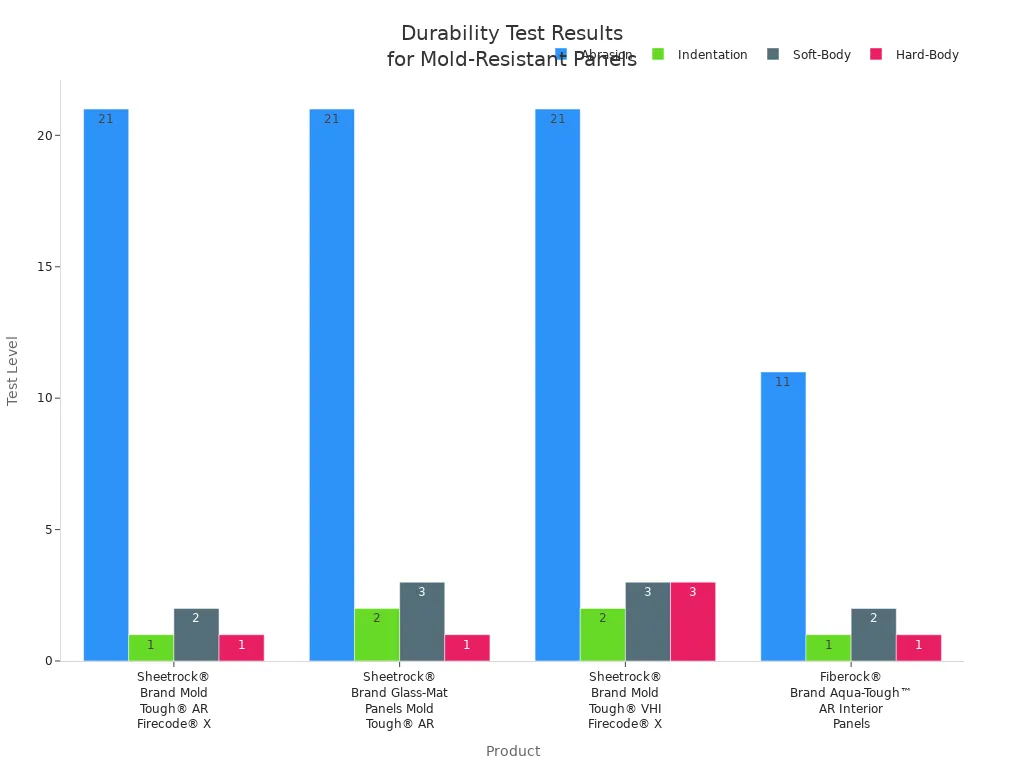
Sheetrock® Brand Mold Tough® AR Firecode® X panels score high for strength. Pick panels with strong durability scores for busy rooms.
Installation
You want installation to be easy and safe. Some panels need special tools or skills to put up. If you install them wrong, you might get leaks or mold. Always follow the instructions. You can ask an expert for help. Good installation keeps your walls dry and safe.
Note: Getting help from a pro can stop expensive mistakes later.
Cost
You want to spend wisely and get good quality. The table below shows what wall panels cost in 2025.
Type of Wall Panel | Cost per Square Foot |
|---|---|
Traditional Drywall | |
Moisture-Resistant Drywall | $0.50 to $0.75 |
PVC Wall Panels | 15-20% higher than drywall |
PVC panels cost more at first, but you save money later because they last longer and need fewer repairs.
Moisture-resistant drywall is cheaper than regular drywall.
Tip: Talk to experts to find the best panel for your money and needs.
Top Alternatives to Drywall
Paperless Drywall
 Paperless Drywall
You can pick paperless drywall for mold resistance. This panel uses fiberglass mats, not paper. Mold cannot eat the material. The panel has less cellulose and less water. Mold finds it hard to grow here. Paperless drywall gets a ’10’ on the ASTM D3273 test, which means it resists mold very well.
Certification/Rating | Description |
|---|---|
ASTM D3273 | Score of ’10’ (highest) for mold resistance |
Mold & Mildew Resistance | Yes |
Pros:
Stops mold and mildew from growing
Works in rooms that get damp
Installs easily like regular drywall
Cons:
Costs more than standard drywall
Needs careful handling to stop rough edges
Best Use Cases:
Use paperless drywall in bathrooms, basements, and kitchens. It fits places with lots of humidity.
MgO Board
MgO board is a strong choice instead of drywall. This panel resists moisture, mold, and mildew. MgO board lasts longer and stops water damage. You can use it in wet rooms like bathrooms and kitchens. It also helps keep indoor air clean.
Pros:
Strong against moisture
Good for keeping walls stable
Eco-friendly and safe
Cons:
Costs more than other panels
Needs special tools to cut
Best Use Cases:
MgO board works best in bathrooms, kitchens, and laundry rooms. Use it for projects needing long-lasting mold protection.
Cement Board
Cement board is a reliable drywall alternative. It resists moisture and is very strong. Cement board does not break down when wet. You can use it behind tiles in showers and on basement walls.
Board Type | Moisture Resistance | Additional Benefits |
|---|---|---|
Cement Board | High | Durable, good for wet places |
Fiber Cement Board | High | Resists water, mold, and fire |
Pros:
Handles water and mold well
Lasts a long time
Works in wet and humid spaces
Cons:
Heavy and hard to cut
Needs special screws to install
Best Use Cases:
Use cement board in showers, laundry rooms, and basements. It is also good for commercial kitchens.
PVC Panels
PVC panels have a surface that does not let water in. Mold and mildew cannot grow on these panels. They resist chemicals, so cleaning does not hurt them. Some PVC panels have extra protection from antimicrobial agents.
PVC panels work in restrooms, kitchens, and commercial spaces. You can install them quickly, and they last a long time.
Pros:
Easy to clean
Fast to install
Cons:
Costs more than drywall
Not many design choices
Best Use Cases:
Use PVC panels in bathrooms, kitchens, and food prep areas. They fit places needing strong moisture protection.
Fiberglass-Faced Drywall
Fiberglass-faced drywall is another mold resistant wall panel. This panel has an inorganic fiberglass mat. Mold cannot grow easily on it. The gypsum core also resists water. It works better than paper-faced drywall in damp places.
Type of Drywall | Mold Resistance Features |
|---|---|
Fiberglass-faced Drywall | Inorganic mat, less likely to get mold |
Paper-faced Drywall | Organic paper, can get mold if wet |
Pros:
Stops mold from growing
Works in high humidity
Easy to install
Cons:
Costs more than regular drywall
Needs careful finishing
Best Use Cases:
Use fiberglass-faced drywall in basements, bathrooms, and kitchens.
DRICORE SMARTWALL
DRICORE SMARTWALL is a modern drywall alternative. It uses Vapour Shield Technology to keep water out of walls. Encapsulated framing with EPS removes air pockets. Water vapor does not condense inside. This lowers the chance for mold, mildew, and rot.
Feature | Contribution to Mold Resistance |
|---|---|
Vapour Shield Technology | Stops water build-up, keeps vapor as gas |
Encapsulated framing with EPS | Removes air pockets, lowers risk of mold, mildew, and rot |
Pros:
Advanced mold resistance
Fast to install
Good insulation
Cons:
Costs more than other panels
Not always easy to find
Best Use Cases:
Use dricore smartwall in basements, finished garages, and home offices. It fits places with moisture risk.
Greenboard
Greenboard is made to resist moisture. This panel absorbs water slowly, stopping mold and mildew. Greenboard works well in kitchens, bathrooms, and basements.
Use Case | Benefits |
|---|---|
Bathrooms | Moisture resistance stops mold and mildew |
Kitchens | Protects against water damage from splashes and humidity |
Basements | Helps stop mold from damp conditions |
Laundries | Good for places with high humidity |
Garages | Gives moisture resistance in damp places |
Pros:
Good moisture resistance
Easy to install
Affordable
Cons:
Not for direct water contact
Less durable than cement board
Best Use Cases:
Use greenboard in bathrooms (not in showers), kitchens, basements, laundries, and garages.
Plywood
Plywood is a classic drywall alternative. It resists water and mold well. Plywood works better than engineered wood in moist places.
Material | Water Resistance | Mold Resistance Suitability |
|---|---|---|
Plywood | Good | Good for moist places |
Engineered Wood | Lower | Best in dry places |
Pros:
Strong and lasts long
Handles moisture well
Easy to cut and install
Cons:
Needs sealing for best mold resistance
Not as smooth as drywall
Best Use Cases:
Use plywood in basements, garages, and utility rooms.
FrameGuard Wood
FrameGuard Wood panels use anti-mold chemicals and borate technology. These panels protect against mold, termites, and decay fungi. The treatment happens in a controlled place for good coverage. These panels are for inside use.
Pros:
Resists mold, termites, and decay
Safe for indoor use
Reliable coverage
Cons:
Not for outside walls
Needs professional installation
Best Use Cases:
Use FrameGuard Wood in basements, crawl spaces, and utility rooms.
GP DensArmor
GP DensArmor is a top drywall alternative for wet spaces. It uses fiberglass mats, not paper, so mold cannot grow. GP DensArmor scored a ’10’ in the ASTM D3273 test, showing no mold after four weeks. You also get a warranty against delamination and damage.
Feature | Description |
|---|---|
Mould Resistance | Scored a 10 in ASTM D3273 test, no mould growth in 4 weeks |
Material Composition | Fiberglass mats, no paper facings |
Warranty | Limited warranty for up to 12 months exposure to normal weather |
Pros:
Excellent mold resistance
Durable and strong
Comes with a warranty
Cons:
Costs more than regular drywall
Needs skilled installation
Best Use Cases:
Use GP DensArmor in bathrooms, basements, and commercial kitchens.
Mold Resistant Wall Panel Comparison
Performance
 Performance
You want your walls to stay strong and clean. Mold resistant wall panel options give you better protection than regular drywall. Some panels, like PVC and cement board, block water and stop mold from growing. Others, such as fiberglass-faced drywall, use non-porous surfaces that are easy to clean. You can find panels that resist dents and scratches, so they last longer in busy rooms.
Waterproof and moisture-resistant panels work best in bathrooms and kitchens.
Mold and mildew resistance keeps your air healthy.
Non-porous surfaces need less cleaning.
Durable panels handle bumps and scrapes.
Many panels come in styles that fit your home.
Installation & Maintenance
You want to save time and money when you put up new panels. Some panels, like PVC, use a tongue-and-groove system. You can install them quickly without special tools. Other panels, such as FRP, need a team and extra backer boards, which makes the job harder and more expensive.
FRP panels take more work and cost more to maintain.
Most mold resistant wall panel choices only need a damp cloth for cleaning.
Durable panels do not need repairs as often.
Tip: Choose panels that match your skill level for installation. You will avoid mistakes and extra costs.
Cost
You want to get the best value for your money. Some panels cost more at first but save you money later. PVC and MgO panels have higher prices, but you spend less on repairs and cleaning. Greenboard and fiberglass-faced drywall cost less but may not last as long in very wet places.
Panel Type | Upfront Cost | Maintenance Cost | Lifespan |
|---|---|---|---|
PVC | High | Low | Long |
MgO | High | Low | Long |
Greenboard | Low | Medium | Medium |
Fiberglass-faced | Medium | Low | Long |
Best Use Cases
You need to pick the right panels for each room.
Bathrooms: Use PVC or cement board for the best moisture protection.
Basements: MgO board and DRICORE SMARTWALL work well in damp spaces.
Kitchens: Fiberglass-faced drywall and PVC panels keep walls clean and dry.
Commercial areas: Choose panels with high durability and easy cleaning.
Quick Comparison Table
Panel Type | Mold Resistance | Installation | Maintenance | Best For |
|---|---|---|---|---|
PVC | Excellent | Easy | Minimal | Bathrooms, kitchens |
MgO Board | Excellent | Moderate | Minimal | Basements, laundry |
Cement Board | High | Hard | Low | Showers, wet areas |
Fiberglass-faced | High | Easy | Low | Kitchens, basements |
Greenboard | Good | Easy | Medium | Garages, laundries |
Drywall Alternatives for Specific Spaces
Bathrooms
Bathrooms often have steam, splashes, and high humidity. You need wall panels that block water and stop mold. For high-moisture areas like bathrooms, MgO panels work well. They are strong, eco-friendly, and easy to install. PVC wall panels also give you a waterproof surface. These panels do not let water in, so mold cannot grow. You can clean them with just a wipe.
MgO panels: Strong, eco-friendly, easy to install
PVC wall panels: Waterproof, easy to clean, mold-resistant
Tip: Choose panels that are made for wet spaces to keep your bathroom safe and healthy.
Basements
Basements often stay damp and can get humid. You want panels that keep out water and stop mold. Duramax PVC wall panels are a top choice. They are completely water-resistant and prevent mold and mildew. Moisture-resistant drywall also works well in basements. It has a special core and treated paper to block moisture. Plastic wall panels are another good option. They resist leaks and mold, making them perfect for basements.
Duramax PVC wall panels: Water-resistant, mold-proof
Moisture-resistant drywall: Blocks moisture, easy to install
Plastic wall panels: Prevent leaks, resist mold
Kitchens
Kitchens need panels that are easy to clean and resist mold. FRP panels have a smooth, non-porous surface. You can wipe away spills and grease with little effort. These panels do not let dirt or germs build up. PVC wall panels also work well in kitchens. They are 100% moisture resistant and stop bacteria and mold from growing. You get a clean and safe cooking space.
Panel Type | Benefits |
|---|---|
FRP panels | Easy to clean, mold-resistant |
PVC wall panels | Waterproof, stops bacteria & mold |
Commercial Areas
Commercial spaces see heavy use and lots of people. You need panels that last and resist water. Trusscore products are 100% moisture and water resistant. Their PVC makeup lets them shed water and block mold. Mold/moisture-resistant gypsum panels also work well. They have anti-microbial properties and protect against mold and mildew. These panels fit busy places like kitchens and washrooms.
Trusscore panels: Water-resistant, durable
Mold/moisture-resistant gypsum panels: Anti-microbial, mold protection
Note: Pick panels that match the needs of your space. This helps you avoid repairs and keeps your building safe.
You can pick from many mold-resistant wall panels. Some good choices are paperless drywall, MgO board, cement board, PVC panels, and fiberglass-faced drywall. These panels help keep your home safe. They also help you save money because you will need fewer repairs. Your house can be worth more if you use these panels.
Benefit | Explanation |
|---|---|
Mold-resistant panels mean you fix and replace walls less often. You save money over time. | |
Waterproof and Mold Resistant | These panels do not soak up water. Mold cannot grow, so your walls stay safe. |
Compliance with Health Codes | These panels help buildings follow health rules. This makes your property worth more, especially in businesses. |
Pick panels that work for your room and your budget. MgO panels are great for wet rooms. They are easy to put up.
MgO panels stop water and mold in bathrooms, kitchens, and basements.
You can cut and snap them fast, so you save time.
Their strong material keeps walls safe in damp places.
Tip: Get a pro to help install your panels. You will get better results and keep your home safe for a long time.
FAQ
What makes a wall panel mold resistant?
Mold-resistant panels use special materials. These include fiberglass, PVC, or treated gypsum. Mold cannot eat these materials. This gives better protection in wet places. Always look for certifications like ASTM D3273 for mold resistance.
Can you install mold-resistant panels yourself?
You can put up some panels by yourself. PVC and paperless drywall are simple to use. Heavy panels like cement board may need help. Always read the instructions for the best results.
Do mold-resistant panels cost more than regular drywall?
You pay more at first for mold-resistant panels. You save money later because you avoid repairs. PVC and MgO panels last longer and need less fixing.
Where should you use mold-resistant wall panels?
Use these panels in bathrooms, basements, kitchens, and laundry rooms. Commercial places like restaurants and hospitals also need them. Wet areas need extra protection from mold.